
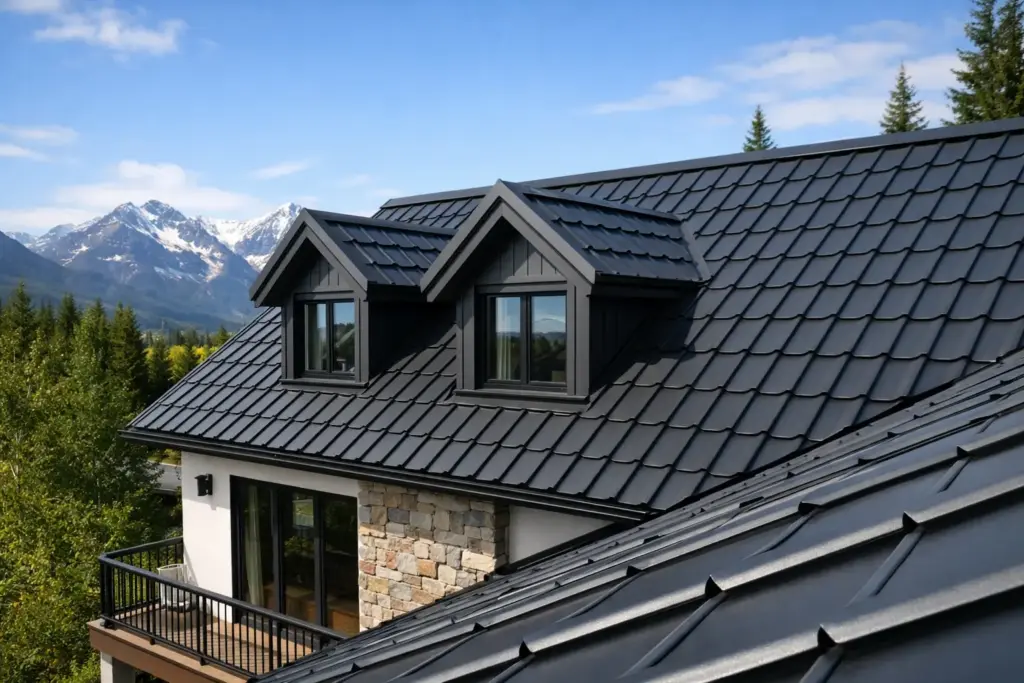
On an acreage outside Calgary or a custom build exposed to open wind, the roof does more than finish the house. It carries snow load, handles freeze-thaw cycles, resists hail, and shapes the entire look of the property. That is why a european style metal roof stands out for Alberta homeowners who want more than a basic replacement.
This is not a trend-driven product category. It is a roofing approach built around long service life, precise detailing, and architectural discipline. For the right property, it can deliver a cleaner exterior, better long-term value, and fewer compromises between appearance and performance.
What defines a European style metal roof
A European style metal roof usually refers to engineered metal roofing profiles influenced by long-established building traditions in Europe. In practical terms, that often means metal tile systems, refined standing seam profiles, and metal shingles designed with tighter tolerances, cleaner lines, and more deliberate accessory integration than many conventional roofing products.
The visual difference matters. These systems tend to look more structured and more architectural than standard exposed-fastener panels. Instead of reading like a utility roof, they read as part of the home design. On higher-value homes, that distinction is significant.
The performance difference also matters. European-engineered systems are often developed around durability, repeatable installation standards, and weather resistance across demanding climates. That does not mean every product performs the same, but the category generally appeals to property owners who are planning beyond the next few years.
Why Alberta homes are a strong fit
Alberta is not forgiving to roofing materials. Heavy snow, sharp temperature swings, chinooks, strong wind exposure, and seasonal hail all put pressure on the roof system. A material that looks good in a mild climate may not hold up the same way here.
That is where metal roofing has a clear advantage when the correct system is selected and installed properly. It sheds snow efficiently, resists moisture-related degradation better than many short-life materials, and performs well through repeated thermal movement when details are done correctly.
A european style metal roof is especially well suited to custom homes, acreage properties, and investment-grade residential builds where the owner wants a roof that complements a premium structure instead of working against it. The cleaner appearance fits modern designs, traditional forms, and transitional architecture without looking temporary or purely functional.
Appearance is part of the investment
On higher-end residential projects, roofing is not just a protective layer. It is a large visual surface that affects curb appeal, resale perception, and how finished the home feels from a distance.
European-style metal tiles and standing seam systems tend to provide sharper shadow lines, more consistent panel geometry, and a more intentional overall profile. That creates a finished look that suits large roof areas, steep slopes, and visible elevations common on acreage homes.
There is also more flexibility than many homeowners expect. Some profiles suit contemporary homes with minimal detailing. Others work well on estate-style builds, country properties, and homes that need the durability of metal without an industrial look. The best choice depends on roof geometry, wall materials, and how prominent the roofline is in the overall design.
Performance depends on the full system
A premium roof product can still underperform if the system around it is weak. This is one of the biggest misunderstandings in roofing. Owners compare material samples, colours, or profile shapes, but the long-term result depends just as much on underlayment strategy, ventilation, flashings, fastener placement, transitions, and installer discipline.
With metal roofing, precision matters. Panel alignment matters. Expansion and contraction planning matters. Snow retention planning matters. So does detailing around valleys, chimneys, skylights, dormers, and wall intersections.
That is one reason premium metal roofing is not a commodity service. The difference between a roof that lasts and a roof that creates service calls often comes down to execution. For Alberta conditions, that standard has to be high from the first measurement to the final trim piece.
European style metal roof vs conventional asphalt
For many homeowners, the comparison starts with price. Asphalt usually has the lower upfront cost. That part is straightforward. What is less straightforward is lifecycle value.
Asphalt can make sense on budget-driven projects or properties with shorter ownership horizons. But on custom homes and higher-value residences, replacement cycles, maintenance concerns, and appearance loss over time often make it the less attractive long-term option. Granule wear, curling, wind damage, and weather-related aging are familiar issues in this climate.
A european style metal roof typically costs more at the start, but it is often chosen to reduce repeat replacement cycles and maintain a stronger appearance over time. That matters for owners who intend to stay in the home, preserve resale value, or avoid revisiting the roof as a recurring capital expense.
The trade-off is simple. The initial investment is higher, and the planning needs to be better. In return, you get a roof system designed for durability, visual consistency, and long-term service.
Not every metal roof is the same
This point deserves clarity. Some property owners hear “metal roof” and assume all systems perform at a similar level. They do not.
There is a substantial difference between an exposed-fastener agricultural panel and a premium architectural metal system. There is also a difference between basic commodity profiles and European-engineered products designed for residential architecture.
Coating quality, steel thickness, profile engineering, accessory design, fastening method, and installation standards all affect outcome. Even colour retention and the way the roof ages visually can vary significantly between systems.
For that reason, selection should not be based on metal alone. It should be based on the complete roof assembly, the property type, and the installer’s experience with that exact category of work.
Where this roof style makes the most sense
European-style metal roofing is a strong fit where the roof is expected to perform as both protection and architecture. That typically includes custom homes, acreage residences, estate properties, duplex developments with long-term hold value, and rebuilds where the owner is upgrading the full exterior standard.
It is also well suited to projects where maintenance access is difficult or recurring roof replacement would be disruptive and expensive. On larger homes with complex rooflines, getting the details right once is often far more economical than dealing with repeated corrections over time.
That said, it is not automatically the right choice for every project. If the home is being renovated strictly to meet a low upfront budget, or if the structure itself does not justify a premium envelope, other systems may be more realistic. Good roofing decisions are not about buying the most expensive option. They are about matching the system to the property and ownership goals.
What to ask before choosing a system
A serious roofing decision should go beyond colour charts and broad warranty claims. Ask how the system handles snow management. Ask how flashings are fabricated and integrated. Ask whether the installer has real experience with standing seam or European-style metal tiles, not just general roofing experience.
You should also ask how the roof will relate to soffits, fascia, wall cladding, and drainage. Premium roofing performs best when it is planned as part of the exterior envelope, not treated as an isolated product swap.
For Alberta homeowners, builders, and investors, that integrated thinking usually separates a strong result from an average one. Companies like Hazinasky Roofing LTD. focus on that full-system approach because premium metal roofing only delivers its value when material quality and installation quality align.
Long-term thinking changes the decision
A roof is easy to underestimate when viewed as a line item. It looks very different when viewed as a 30-plus-year asset tied directly to maintenance costs, structural protection, and property value.
That is why a european style metal roof continues to gain attention on premium residential projects. It offers a combination that is difficult to replicate with short-life materials – refined appearance, strong weather performance, and a more disciplined path to long-term ownership.
If the goal is to install a roof once, have it suit the architecture, and trust it through Alberta weather, this category deserves serious consideration. The right roof should not just survive the climate. It should still look like it belongs on the home years after the project is finished.
One Response