
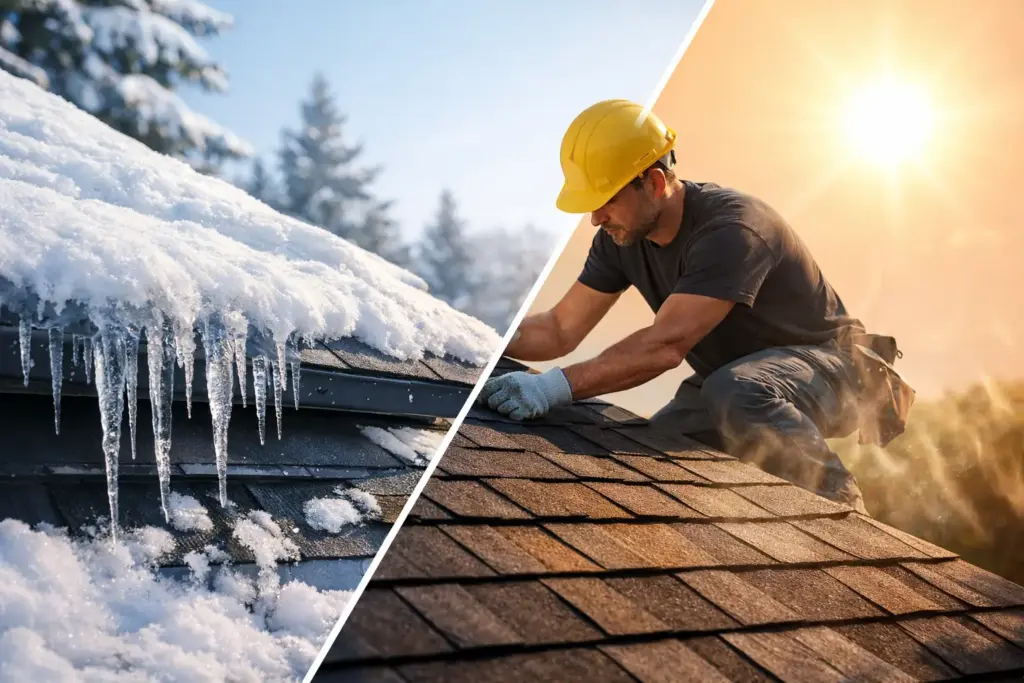
A roof can look perfectly fine in October and start showing weaknesses by February. In Alberta, that shift happens fast. Roofing for extreme temperature swings is not just about handling cold winters or hot summers in isolation. It is about surviving constant expansion, contraction, freeze-thaw cycling, wind exposure, snow load, and sudden weather reversals without losing performance.
For homeowners, builders, and property investors working on higher-value properties, that changes the conversation. The real question is not what roof costs less on day one. It is which system will stay stable, watertight, and visually clean after years of punishment from a climate that does not behave gently.
What extreme temperature swings actually do to a roof
Large temperature variation puts every roofing system under stress. Materials heat up, expand, cool down, and contract. That movement happens again and again across seasons, but also within the same week, and sometimes within the same day.
On a low-performance roof, that repeated movement starts to show up at the weakest points first. Fasteners loosen. Sealants dry out or crack. Flashings separate. Panels shift. Brittle materials lose integrity. Water finds entry points, and once moisture gets in, freeze-thaw conditions make the damage worse.
This is why climate suitability matters just as much as product selection. A roofing material that performs adequately in a mild region can become a maintenance problem in Alberta. The issue is rarely just the top layer. It is the full assembly, including ventilation, underlayment, fastening method, flashing design, and installation precision.
Roofing for extreme temperature swings starts with material stability
Not all roofing materials respond to thermal movement the same way. Some absorb the punishment better. Some age faster under repeated stress. Some depend heavily on short-lifecycle components that tend to fail before the roof itself should.
Asphalt-based systems can work in many markets, but they are more vulnerable to temperature-driven ageing, granule loss, curling, and shortened service life in harsher conditions. That does not mean every asphalt roof fails quickly. It means the margin for error is smaller, and the long-term maintenance picture is often less predictable when the climate is severe.
Premium metal roofing stands out because it is built for movement rather than fighting against it. Properly designed metal systems account for thermal expansion and contraction within the panel and fastening strategy. That is a major reason they perform well in demanding climates. The material itself remains stable, and the system can be engineered to manage movement without tearing itself apart over time.
That said, not all metal roofing is equal. Exposed-fastener systems and lower-grade installations can create their own problems. If the fastener pattern, panel profile, or detailing is wrong, even metal can underperform. Material quality matters, but system design and installation matter just as much.
Why standing seam performs well in Alberta
For roofing for extreme temperature swings, standing seam metal roofing is often one of the strongest long-term choices. The reason is straightforward. It is designed as a high-performance system, not just a decorative covering.
Standing seam panels are typically concealed-fastener systems, which reduces exposure at one of the most failure-prone points on any roof. The raised seams help manage water runoff, and the panel design allows for controlled thermal movement. That matters in a province where roofs may go from deep freeze to strong solar gain in a short period.
It also suits the kind of properties where lifecycle performance matters. On acreage homes, custom builds, and architecturally driven residences, a standing seam roof offers both structural reliability and a cleaner visual result. It looks disciplined because it is a disciplined system.
There are trade-offs, of course. Initial cost is higher than basic roofing options. It also demands a more skilled installer. A premium system installed poorly is still a poor investment. But when the goal is to install once and avoid repeated replacement cycles, the economics often improve over the life of the property.
Installation quality decides whether the roof actually performs
A roof designed for harsh conditions still depends on execution. This is where many failures begin. The issue is not always the product. It is often the gap between what the material was designed to do and how it was installed in the field.
In extreme climates, details carry more weight. Flashing transitions need to be precise. Penetrations need to be treated as critical points, not routine add-ons. Ventilation needs to support the building envelope properly. Underlayments must suit cold-weather performance. Fasteners, clips, and trims must be selected and installed with movement and weather exposure in mind.
This is especially important on custom homes with multiple rooflines, valleys, dormers, elevation changes, and integrated exterior features. Complexity increases risk. A clean-looking roof from the ground can still hide weak detailing if the installer lacks system-specific discipline.
That is one reason premium property owners tend to move away from generalist roofing approaches. A specialized installer understands that performance comes from the assembly as a whole, not from a product brochure.
Snow, ice, and solar heat add another layer of stress
Alberta roofs do not just deal with temperature swings in abstract terms. They deal with snow accumulation, drifting, ice formation, chinook-driven melt cycles, and strong sun exposure. Those conditions interact with the roof system constantly.
Snow load affects structural planning and water management. Ice buildup tests edge detailing and drainage paths. Sudden warming events can expose weak spots fast if melting snow finds an entry point. Strong solar gain can amplify thermal movement, especially on darker roof surfaces and exposed slopes.
This is where metal roofing often delivers another advantage. It sheds snow differently, responds well to engineered snow management accessories, and resists many of the deterioration patterns seen in shorter-lifecycle materials. But again, this only works if the roof is designed as a complete system. Snow retention, flashing, ventilation, and panel layout all need to be considered together.
The wrong roof is not always obvious right away
One of the more expensive mistakes in residential construction is assuming a roof is performing because it has not leaked yet. Temperature-related wear often develops slowly, then shows up all at once through interior staining, trim movement, ice issues, or localized failure around penetrations and transitions.
For investors and property owners, that delayed failure matters. It can disrupt tenants, damage insulation and sheathing, affect resale confidence, and create repair costs that extend beyond roofing. A cheaper roof does not stay cheap once it starts affecting the rest of the building envelope.
That is why lifecycle value matters more than headline price. A roof on a high-value property should be judged the same way as other capital decisions – by service life, risk reduction, maintenance exposure, and contribution to long-term asset value.
What to look for when choosing roofing for extreme temperature swings
The right roofing decision starts with the property, not just the product. Roof pitch, architectural style, exposure to wind, snow patterns, rural location, and expected ownership timeline all matter.
A homeowner planning to stay long term may prioritize durability and minimal maintenance. A builder may need a system that supports design intent while protecting reputation. An investor may focus on reducing future repair cycles and preserving property value. Those goals are different, but they all point toward the same principle: the roof must suit the climate and the property standard.
When evaluating options, ask practical questions. Is the system designed to accommodate thermal movement? Are the fasteners exposed or concealed? How are valleys, eaves, penetrations, and transitions handled? What does the expected maintenance profile look like after ten or fifteen years, not just after the first winter?
For many Alberta projects, that leads toward premium metal systems, particularly when the property itself is being built or upgraded for long-term ownership. Hazinasky Roofing LTD. works in that category deliberately, with a focus on roofing systems that match the demands of the climate and the quality level of the home.
A roof in Alberta should not be chosen like a finish item. It should be chosen like a structural decision with architectural consequences. Extreme temperature swings expose weak systems early and punish mediocre workmanship even faster. If the goal is lasting protection, stable performance, and a roofline that still looks right years from now, the better path is usually the one built around precision, not shortcuts.
The best roofing decisions tend to feel expensive only once. The wrong ones keep sending invoices.
One Response