
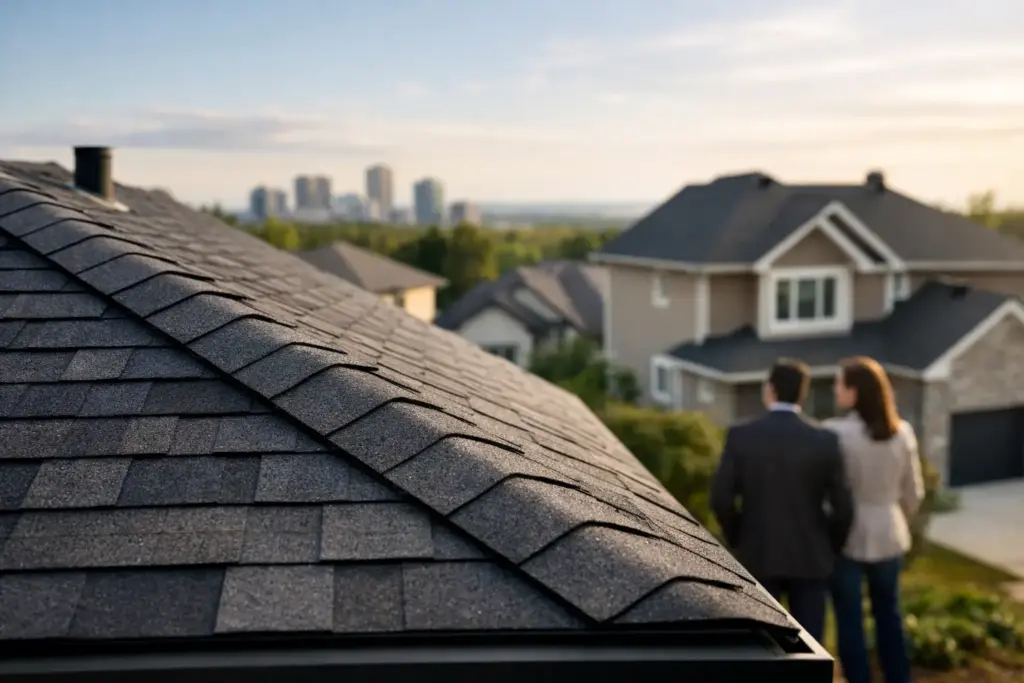
A roof fails quietly at first. A few lifted shingles after a Chinook. Ice backing up at the eaves. A small stain in the top-floor ceiling that turns into insulation damage, drywall repair, and a tenant complaint. For anyone evaluating a roof system for property investors, that pattern matters more than brochure claims. The right roof is not just a finish material. It is a long-term risk decision tied directly to maintenance cost, asset protection, and resale value.
Investors often get pushed toward the cheapest replacement option because the upfront number looks clean. That approach can work on a short hold or a lower-value property where the exit timeline is tight. On higher-value residential assets, custom builds, acreage homes, and properties exposed to Alberta’s weather extremes, cheap roofing usually stops being cheap once the callbacks, repairs, and early replacement cycle begin.
What a roof system for property investors should actually do
A roof should do more than keep water out. On an investment property, it needs to control long-term costs, reduce disruption, and support the property’s market position. If the home is architecturally strong but the roof looks worn, uneven, or out of place, buyers notice. If the material choice cannot handle wind, snow load changes, freeze-thaw cycles, and summer heat, ownership notices.
That is why the word system matters. Roofing performance comes from the full assembly – material, underlayment, flashings, ventilation details, fastening method, slope suitability, edge treatment, and installation quality. A premium roof panel installed with weak detailing is still a weak result. The investor’s question should not be, “What is the cheapest roof I can buy?” It should be, “What system gives this property the best long-term outcome?”
Why Alberta changes the calculation
Alberta is hard on roofs. Snow loads can be substantial, winds can be aggressive, hail is a real concern in many areas, and temperature swings are not minor. Materials expand and contract. Fasteners and seal points get tested. Water management details become critical when ice and melt cycles repeat through the season.
This is where lifecycle thinking separates itself from first-cost thinking. A product that performs adequately in a mild climate may not deliver the same result on an exposed acreage, a custom home outside the city, or an investment property where deferred maintenance can stack up quickly. Investors who plan to hold for years need a roofing choice built for abuse, not just code minimums.
The strongest options are not always the cheapest
Asphalt shingles still dominate much of the market because they are familiar and relatively inexpensive to install. For certain properties, they remain a practical choice. But they also bring a shorter service life, more visible aging, and greater vulnerability to wind uplift, granule loss, and repeated replacement cycles.
For higher-value properties, premium metal roofing changes the math. Standing seam metal, European-style metal tiles, and engineered metal shingle systems offer a different ownership profile. The upfront investment is higher. The expected service life is longer. The appearance stays cleaner over time. Maintenance demands are generally more predictable when the system is designed and installed correctly.
That does not mean metal is automatically the right answer for every investor. If the property is being repositioned quickly for sale, budget may outweigh long-term lifespan. If the structure has design constraints or surrounding features that affect runoff and snow shedding, system selection needs care. But for investors holding quality assets in Alberta, metal often deserves serious attention because it aligns with the same principle that drives better portfolio decisions – spend once where failure is expensive.
Roof system for property investors: where return really comes from
The return on a better roof rarely shows up as one dramatic number. It appears in avoided problems and stronger property performance over time.
First, there is maintenance stability. A roof that holds its integrity longer reduces emergency repairs, patchwork service calls, and the hidden management cost of dealing with preventable issues. That matters whether the property is owner-occupied, tenant-occupied, or positioned for resale.
Second, there is asset protection. Water intrusion does not stay in the roof assembly. It moves into insulation, sheathing, ceilings, wall assemblies, and finishes. Once that happens, the repair scope broadens fast. Paying more for a system with stronger detailing and better weather resistance is often far less expensive than repairing secondary damage.
Third, there is market perception. On custom homes and premium residential properties, the roof is a major visual surface. A crisp standing seam profile or a well-chosen European metal tile can elevate the entire exterior. Buyers and appraisers may not always itemize the roof in detail, but they respond to the overall impression of quality, permanence, and care.
Installation quality decides whether the system performs
Investors sometimes compare roofing prices as if they are comparing identical goods. In reality, the gap between bids often reflects more than material choice. It can reflect different approaches to detailing, accessory components, labour quality, and system integration.
The vulnerable points are rarely the large open roof fields. Failures usually start at transitions, valleys, penetrations, skylights, wall connections, and edges. Snow retention planning matters. Flashing design matters. Substrate preparation matters. So does understanding how a specific metal profile behaves under Alberta conditions.
A premium roofing product installed by a crew without specialized experience can become an expensive lesson. This is one reason investors working on higher-value properties tend to favour specialists over generalists. Precision is not a marketing term in roofing. It is the difference between a roof that looks good on handover and one that continues performing years later.
Matching the roof to the property type
Not every investment property deserves the same specification. The right answer depends on hold period, asset class, location, architecture, and operating model.
For acreage homes and custom residential investments, architectural fit carries more weight. A roof needs to complement the scale and character of the home while standing up to more exposed weather conditions. Premium metal systems are often a strong fit here because they combine design discipline with long service life.
For rental properties, operating predictability becomes central. A roof that minimizes repair calls and disruption can justify a higher initial spend, especially if tenant quality and property presentation are part of the investment strategy.
For resale-focused projects, it depends on the target buyer. In some cases, a high-performance roof becomes a differentiator that supports the asking price. In other cases, the market may not fully reward the upgrade. That is not a reason to ignore quality. It is a reason to choose strategically.
What investors should ask before choosing a system
A serious roofing decision starts with better questions. What is the realistic hold period for the property? How exposed is the site to wind and drifting snow? Is the roof geometry simple or full of transitions and penetrations? Does the exterior design call for architectural refinement, or is pure function the priority? What will maintenance look like over ten, twenty, or thirty years?
It is also worth asking what failure would cost. Not just replacement cost, but interior repairs, occupant disruption, insurance complications, and damage to the property’s reputation in the market. When those costs are accounted for, the cheapest quote often stops looking efficient.
For Alberta investors focused on quality assets, this is where a contractor’s role matters. A company such as Hazinasky Roofing LTD. is not simply supplying panels or replacing shingles. The value is in specifying a complete exterior solution that suits the building, the climate, and the ownership horizon.
The long-term view usually wins
A roof is easy to undervalue because, when it works, nobody thinks about it. But from an investor’s perspective, that is exactly the point. Good roofing should become operationally quiet. No recurring fixes. No visible decline after a few hard seasons. No mismatch between the quality of the home and the quality of its exterior protection.
The best roof system for property investors is rarely the one with the lowest entry price. It is the one that fits the property, holds its appearance, resists Alberta weather, and keeps future decisions simple. Install it once. Done right.
If you are making a roofing decision on a property that matters, treat the roof like capital planning, not cosmetic maintenance. The numbers tend to look better that way over time.