
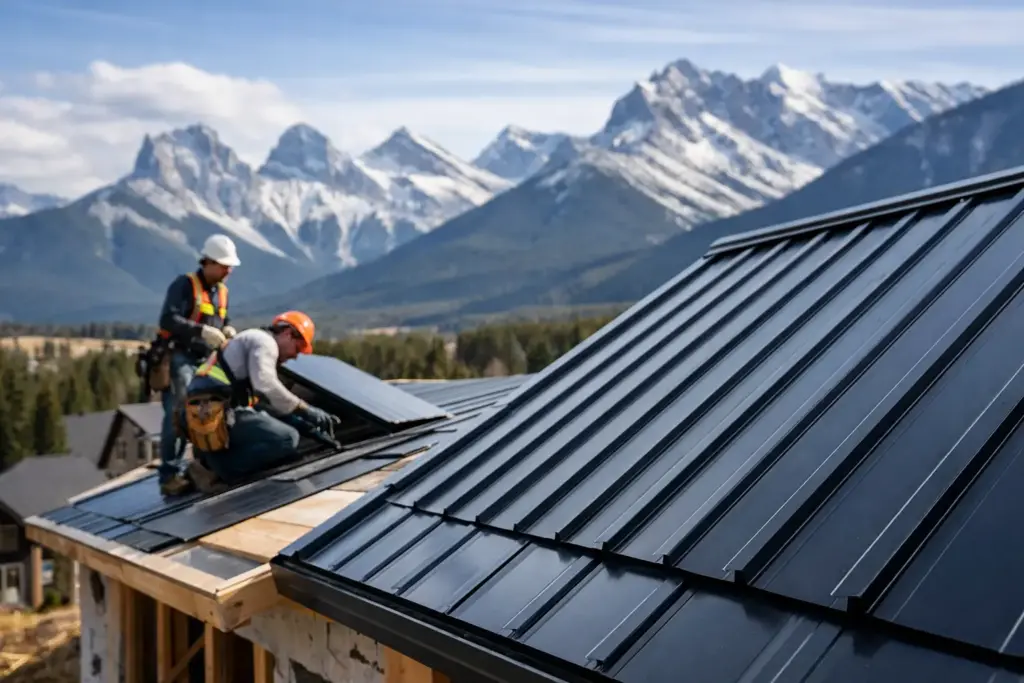
A roof choice can quietly improve a build – or create years of callbacks. For custom homes, acreage properties, and higher-value residential projects, metal roofing for builders is often less about trend and more about control. Control over lifespan, detailing, maintenance risk, and how the finished home presents in a demanding Alberta climate.
Builders already know the pressure points. A roof has to stand up to snow load, wind exposure, rapid freeze-thaw cycles, and strong summer sun. It also has to fit the design intent of the home, satisfy owner expectations, and avoid becoming the weak point in an otherwise premium build. That is where a properly specified metal roofing system starts to make practical sense.
Why metal roofing for builders makes sense
On the right project, metal roofing solves several problems at once. It offers a long service life, strong weather resistance, and a sharper architectural finish than many lower-cost roofing materials. For builders working on custom homes, that matters. The roof is one of the largest visual surfaces on the property, and it has a direct effect on how the home is perceived from the street, the driveway, and the resale market.
There is also the issue of lifecycle cost. Metal roofing usually carries a higher upfront material and installation price than asphalt. That part is obvious. What matters more is what happens over the next 20, 30, or 40 years. Fewer replacements, less ongoing deterioration, and lower risk of premature failure can shift the economics significantly, especially for clients who plan to stay long term or who want to protect a high-value asset properly.
That does not mean metal is automatically the right answer on every build. Budget-sensitive projects with shorter ownership horizons may still lean toward conventional roofing. But for builders serving clients who care about durability, appearance, and predictable performance, metal deserves serious consideration early in the design phase.
Alberta conditions change the conversation
Roofing decisions in Alberta are rarely theoretical. Snow accumulation, high winds across open land, hail exposure, and major temperature swings are not edge cases here. They are standard design realities. A roof system that performs adequately in a mild climate may not hold up the same way on an exposed rural build or a large custom home outside city limits.
This is one reason specification matters so much. Not all metal roofs are equal, and not all installations are built for the same level of climate stress. Panel profile, fastening method, underlayment strategy, ventilation design, flashing execution, and substrate preparation all affect real-world performance. Builders who treat metal roofing as a premium system rather than a simple material upgrade usually get better long-term results.
Standing seam, for example, is often a strong fit where clean lines, weather resistance, and long-term service life are priorities. Metal tiles and metal shingles can also be excellent choices when the design calls for a more traditional roof appearance without giving up the durability benefits of steel. The right product depends on pitch, exposure, architecture, and client priorities.
Design value matters on custom builds
On higher-end homes, the roof is not just a protective layer. It is part of the architecture. Builders working with designers, homeowners, and property investors often need roofing that complements the form of the building instead of flattening it.
This is where premium metal systems tend to stand apart. They deliver cleaner edges, more deliberate profiles, and a more refined finished look. On modern and transitional homes, standing seam can reinforce the geometry of the structure. On estate-style or European-influenced homes, metal tile profiles can provide a more traditional roofline with better longevity than many conventional alternatives.
The trade-off is that premium appearance requires premium execution. The cleaner the design, the less room there is to hide weak detailing. Poorly handled penetrations, uneven layout, loose trim work, or careless flashing can undermine the entire effect. Builders who want the roof to support the architecture need installation standards that match the expectations of the project.
The builder’s real concern: fewer problems after handover
A roofing system should not create a chain of future service calls. That is one of the strongest arguments for specifying quality metal on the right projects. When properly installed, metal roofing can reduce common issues tied to aging, curling, granule loss, and repeated replacement cycles.
For builders, that can mean fewer post-construction headaches and better confidence when handing over a finished home. It also supports the broader reputation of the build. A premium home with a short-lifecycle roof creates a mismatch that buyers notice eventually, if not right away.
That said, metal does not eliminate all risk. The quality of installation remains critical. A premium panel installed poorly is still a problem. Expansion and contraction must be accounted for. Flashings must be integrated properly. Snow management must be considered where roof geometry and entrances make it necessary. The material is durable, but the system only performs as well as its detailing.
Choosing the right metal roofing system
Builders benefit from looking at the roof as a full assembly, not a product line item. The first question is usually not Which metal roof is best. It is Which system fits this home, this exposure, and this client’s expectations.
Standing seam is often chosen for modern custom homes, low-maintenance ownership goals, and projects where architectural clarity matters. Metal shingles and European-style metal tiles can suit more traditional home designs while still delivering the resilience and lifespan advantages associated with steel roofing. In some cases, the visual fit of the profile matters just as much as the technical specification.
Pitch also affects the decision. Some profiles perform better or look more natural on certain slopes. Site exposure matters too. Open acreage homes often deal with stronger wind and more aggressive weather than sheltered urban infill projects. Builders who match the system to these realities tend to avoid compromise later.
Installation quality is the real dividing line
Many roofing materials can look acceptable on day one. What separates strong projects from weak ones is how they perform after several Alberta winters. That is why installation quality is not a sales talking point. It is the deciding factor.
Premium metal roofing requires disciplined layout, precise trims, well-planned transitions, and proper sequencing with the rest of the envelope. Roof-to-wall interfaces, valleys, chimneys, skylights, and ventilation details all need to be handled with care. If they are not, the advantages of the material get diluted quickly.
This is especially relevant for builders who are protecting a premium brand of their own. A roof installed to a commodity standard does not belong on a custom build. Specialists such as Hazinasky Roofing LTD. are often brought in precisely because metal roofing is less forgiving of casual workmanship and far more visible when done incorrectly.
Budget, value, and the client conversation
Some clients will focus immediately on upfront price. That is fair. Metal roofing usually costs more at the start, and builders should not pretend otherwise. The better conversation is about what the client is buying.
They are buying longer-term performance, stronger visual finish, and a lower likelihood of cycling through replacement roofing during ownership. They are also buying a roof system that makes sense for Alberta conditions rather than one chosen mainly because it was cheaper on tender day.
For investors and property owners holding quality assets, this framing is often straightforward. For custom homeowners, it helps to connect the roof choice to the broader standard of the build. If they are investing in a well-designed home, durable cladding, quality windows, and refined exterior detailing, the roof should belong in that same category.
What builders should settle before construction starts
The best metal roofing outcomes usually come from early coordination. Roof design, drainage, penetrations, snow retention requirements, soffit and fascia details, and wall transitions should be considered before the project reaches the install stage. Waiting too long can force compromises that affect both appearance and performance.
This is particularly true on custom homes with complex geometry. Multiple valleys, dormers, steep transitions, and mixed exterior materials can all be managed well, but they need planning. A disciplined pre-construction conversation is usually cheaper than correcting avoidable field issues later.
Builders who take this approach tend to get a cleaner process and a better result. The roof becomes an integrated part of the build instead of a late-stage package that has to work around earlier decisions.
For Alberta builders, metal roofing is not simply an upgrade category. On the right project, it is a better way to align durability, design quality, and long-term ownership value. If the goal is to build a home that still looks right and performs properly years from now, the roof should be chosen with that same standard in mind.