
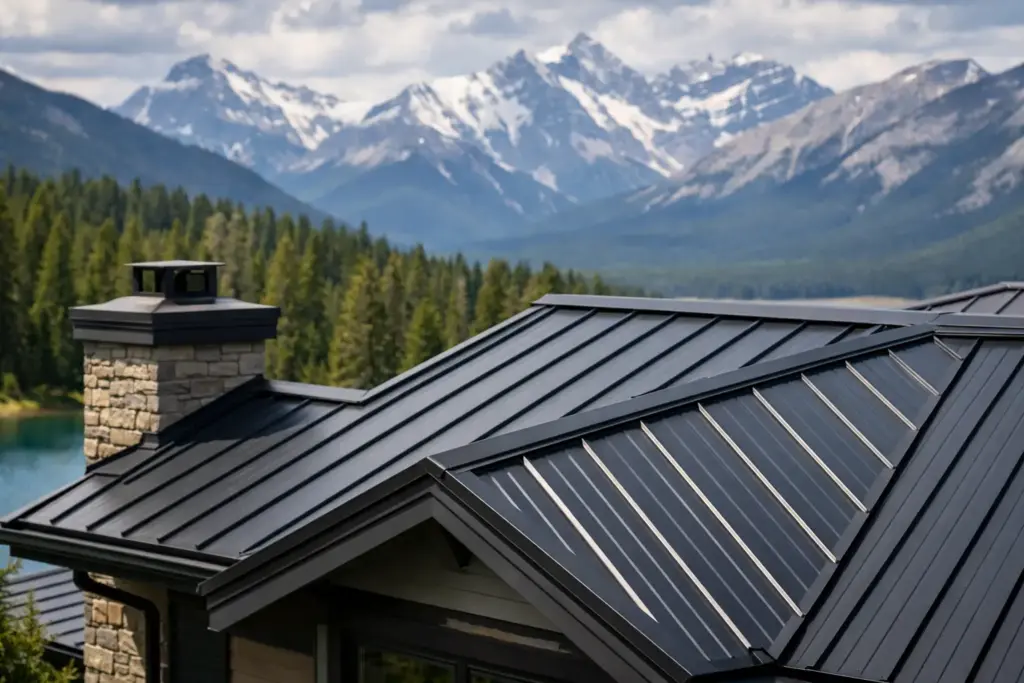
If your roof has to handle prairie wind, heavy snow loads, hail exposure, and freeze-thaw cycles year after year, the real question is not simply is metal roofing worth it. The better question is whether the roof you install now will still be performing properly decades from now, without becoming a recurring repair item.
For many Alberta properties, especially acreage homes, custom builds, and higher-value residences, metal roofing earns its place because it is built around longevity. That does not mean it is the right choice for every house or every budget. It does mean the value conversation needs to go beyond upfront price.
Is metal roofing worth it when you look past upfront cost?
If you compare metal roofing to basic asphalt on installation day alone, metal often loses on price. Premium systems cost more to manufacture, more to detail properly, and more to install well. That part is straightforward.
Where the equation changes is over the full life of the roof. A well-designed and properly installed metal roof can last several times longer than lower-cost alternatives. It is also less likely to curl, degrade, or require repeated patchwork after Alberta weather does what Alberta weather does.
For owners who plan to stay in the home, the value is usually strongest. You are paying more once in exchange for a longer service life, lower maintenance pressure, and a cleaner long-term ownership path. For investors and builders, the answer depends more on hold period, market position, and whether the property itself justifies a premium exterior system.
What makes metal roofing a strong fit for Alberta
Alberta is hard on roofs. Temperature swings can be sharp. Snow accumulation can be significant. Wind is a real design factor, especially on open rural properties and acreages. In many areas, roofs also need to stand up to intense summer sun and seasonal hail.
That is where premium metal systems have a practical advantage. They are not absorbing moisture the way some conventional materials do. They are not aging in the same way under repeated thermal movement. And when designed correctly, they offer excellent resistance to wind uplift and a more stable performance profile over time.
On custom homes and larger residential properties, roof geometry also matters. Complex rooflines, valleys, transitions, and architectural details expose weaknesses quickly when a lower-grade system is used or when installation standards slip. Metal roofing, particularly engineered standing seam and other premium profiles, gives more control over those details when handled by specialists.
Lifespan is where the value starts to separate
The main reason many owners choose metal is simple: they do not want to reroof again any time soon.
A premium metal roof is a long-horizon investment. While exact lifespan depends on profile, substrate, coating system, ventilation, and installation quality, it is common for metal to outlast asphalt by a wide margin. That changes the economics of ownership.
Instead of budgeting for another major roof replacement in the future, many owners can focus on routine inspections and basic maintenance. On a high-value home, that matters. Roofing is not a small cosmetic line item. It is one of the most exposed and critical parts of the building envelope.
If you are building a forever home, renovating a long-term family property, or improving an acreage residence where access and replacement logistics are more involved, the extended service life is often enough on its own to justify serious consideration.
Maintenance is lower, but not zero
One common mistake is assuming metal roofing is maintenance-free. It is not. Any roof system should be inspected periodically, especially after major weather events.
That said, metal generally offers a more predictable maintenance profile. You are less likely to deal with widespread granule loss, curling, brittleness, or the gradual decline that often leads to piecemeal repairs on aging asphalt roofs. Fasteners, flashings, sealants, penetrations, snow management details, and drainage paths still need attention, but the roof system itself is usually more stable over time.
For property owners managing multiple assets, lower maintenance frequency can be a meaningful financial advantage. For homeowners, it often translates into fewer surprises.
Appearance matters more than many people admit
On premium residential projects, the roof is not just weather protection. It is part of the architecture.
This is one area where metal roofing often outperforms expectations. Clean lines, crisp detailing, and profile consistency give a home a more deliberate appearance. Standing seam, European-style metal tiles, and metal shingles each create a different visual result, but all can support a more refined exterior than a standard builder-grade roof.
That matters on custom homes because the roof covers a large percentage of what people see. A strong roof profile can elevate the whole property. It can also align better with modern, transitional, rural luxury, and architecturally disciplined designs.
If the home itself is high quality, a short-lifecycle roof can look and feel out of step with the rest of the build. In that context, metal is not just a performance upgrade. It is a design decision that protects the integrity of the project.
Is metal roofing worth it for resale?
It can be, but resale value depends on the type of buyer and the quality of the installation.
A premium metal roof does not guarantee dollar-for-dollar recovery in every sale. Real estate does not work that neatly. But it can strengthen marketability, especially for buyers who understand long-term ownership costs and want fewer major capital items looming after purchase.
On acreage homes and custom properties, that advantage can be more noticeable. Buyers in that segment often pay attention to construction quality, durability, and maintenance outlook. A premium roof system signals that the property was built or upgraded with a longer-term mindset.
Just as important, a poorly installed metal roof can work against value. Oil canning, sloppy trim work, weak flashing details, or bad transitions will be visible and can create functional issues. Material quality matters, but execution matters just as much.
When metal roofing may not be worth it
There are cases where the answer is no.
If you plan to sell very quickly and your local market will not recognize the premium, the return may be limited. If the property is modest and the roof system would overshoot the value of the home, the numbers may not make sense. And if the installation is being priced by contractors without true metal specialization, the risk increases.
Metal roofing is also not one thing. There is a major difference between premium engineered systems and lower-end products installed without proper detailing. Choosing metal simply because it sounds durable is not enough. The system has to fit the structure, the climate, and the architectural intent.
That is why the lowest quote can be misleading. If corners are cut on underlayment, ventilation, trim, fastening strategy, or snow retention planning, a premium material can still produce a poor result.
The installation standard is part of the product
This is where many value discussions fall apart. Owners compare material categories without accounting for the fact that roofing performance depends heavily on installation quality.
With metal roofing, precision matters. Panel layout, substrate condition, flashing design, expansion and contraction planning, edge details, and penetration treatment all affect long-term performance. The roof is only as dependable as the people specifying and installing it.
For Alberta properties, that standard needs to reflect local conditions. Snow behaviour, wind exposure, rural site realities, and steep seasonal changes should all be part of the planning process. Hazinasky Roofing LTD. approaches metal roofing as a complete exterior system decision, not a commodity replacement. That difference is often what determines whether the roof performs for decades or becomes an expensive disappointment.
So, is metal roofing worth it?
If you care most about the cheapest upfront option, probably not.
If you care about long-term durability, reduced replacement cycles, strong weather performance, architectural quality, and a roof system that matches the value of the property, the answer is often yes. Especially in Alberta, where roofing materials are tested hard and failure is rarely cheap.
The right way to judge metal roofing is not by asking what it costs today. Ask what it will cost you to own the roof over 20, 30, or 40 years, and whether you want to solve this problem once or keep revisiting it. For the right home, that answer becomes very clear.