
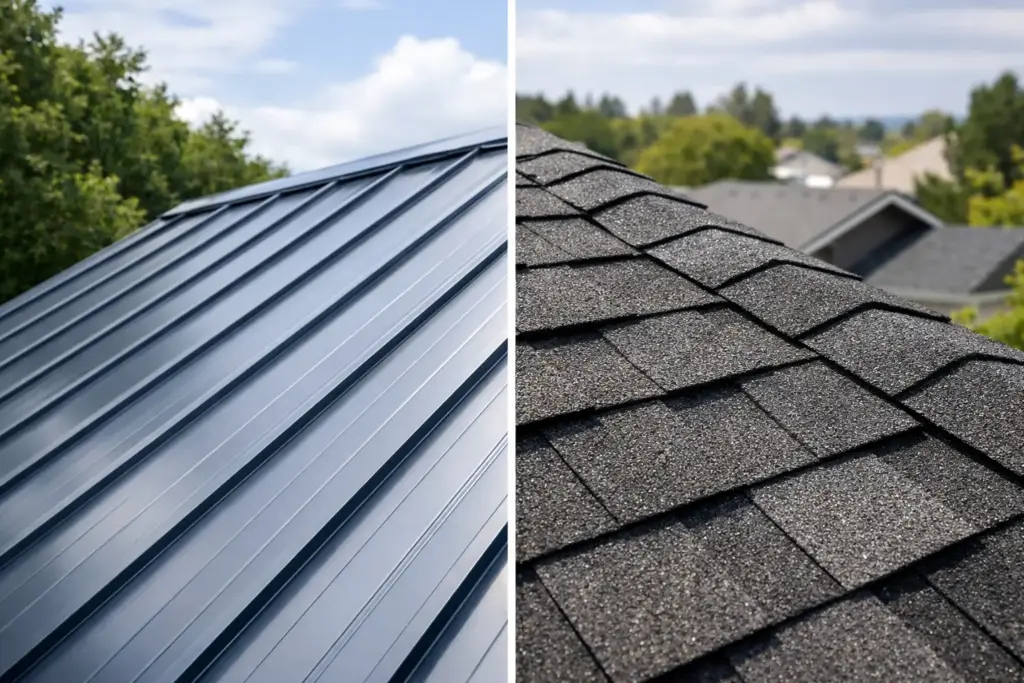
A roof decision made for an Alberta acreage home is rarely just about the next few years. It affects snow management, maintenance planning, insurance conversations, curb appeal, and the long-term condition of the structure beneath it. When comparing a metal roof versus asphalt roof, the right answer depends on your budget, architectural goals, how long you intend to own the property, and the level of performance your home requires.
Asphalt shingles remain a familiar, lower-cost choice. Metal roofing requires a higher initial investment, but it is designed for a much longer service life when the material, detailing, ventilation, and installation are handled correctly. For custom homes and high-value properties exposed to Alberta weather, that difference deserves a closer look.
Metal Roof Versus Asphalt Roof: The Real Difference
The most immediate distinction is lifecycle. A properly installed asphalt shingle roof commonly serves a home for roughly 15 to 30 years, depending on product grade, exposure, attic conditions, storm damage, and maintenance. Metal roofing systems can perform for several decades longer. The exact lifespan varies by system and environment, but premium metal is generally selected by owners who want to avoid repeated replacement cycles.
That longer horizon changes the financial conversation. Asphalt can be less expensive at installation, which may make sense for a short-term holding period, a modest renovation budget, or a property where the roof is not expected to carry a premium architectural role. However, replacement is not limited to shingles. Future roofing work also involves labour, disposal, flashing, site disruption, and the risk of discovering damage after the existing roof is removed.
Metal shifts more of the investment to the beginning of the project. In return, it can reduce the frequency of major roofing work and provide a more stable exterior finish over the years. For a homeowner building once or planning to remain in the home long term, the cost should be measured over decades rather than against the lowest replacement quote available today.
Alberta Weather Changes the Calculation
Alberta roofs face conditions that expose weak points quickly: deep snow loads, freeze-thaw cycles, strong wind events, intense sun, hail, and sharp temperature changes. No roof material is indestructible, and no system performs well without proper installation. Still, metal and asphalt respond to these pressures differently.
Snow, ice, and drainage
Metal has a smooth, hard surface that allows snow to shed more readily than textured asphalt shingles. This can be an advantage on roofs designed with appropriate slope, snow retention, and safe drainage planning. It can also create a hazard if snow slides unexpectedly above entries, walkways, decks, driveways, or lower roof sections.
A professional metal roof design accounts for snow guards, panel layout, valley details, eave protection, and the areas below the roofline. Snow shedding is not a feature to treat casually. It needs to be controlled.
Asphalt shingles tend to hold snow longer, which can reduce sudden snow release but leaves the roof carrying snow for a longer period. In either case, the roof structure must be designed for local snow loads. Material choice does not replace sound framing and drainage planning.
Wind and temperature movement
Quality metal roofing systems are engineered with concealed fastening and expansion details that allow panels to move with temperature changes. This is particularly relevant in Alberta, where a roof may experience significant heat and cold variation across a year, and sometimes within a single day.
Standing seam metal roofing can provide excellent wind resistance when it is installed to the manufacturer’s system requirements and secured to a suitable deck. The critical phrase is “when installed correctly.” Fastener placement, clip spacing, edge detailing, underlayment, and flashing work together. A premium panel cannot compensate for poor execution.
Asphalt shingles also perform well in many Alberta applications, especially higher-grade products installed with proper nailing patterns and sealed correctly. Their performance can decline as shingles age, lose granules, curl, or become vulnerable at lifted edges. Wind damage often begins at these small points of failure.
Hail and surface damage
Hail is one area where homeowners should avoid blanket claims. Metal can dent under a severe hail event, particularly on certain profiles and gauges. A dent may be cosmetic rather than a water-entry issue, but it can matter greatly on a highly visible roof. Asphalt shingles may lose granules, crack, or sustain damage that is less obvious from the ground.
The right choice depends on the specific product, roof geometry, local exposure, insurance requirements, and your tolerance for cosmetic change. A contractor should be able to explain the expected behaviour of the selected system rather than promise that any roof is “hail-proof.”
Appearance Is More Than a Finish Choice
Asphalt shingles offer familiarity and a broad range of colours. They can suit traditional homes, straightforward rooflines, and projects where the roof is intended to stay visually quiet. They are also easier to blend into established neighbourhood streetscapes where shingle roofing dominates.
Metal creates a cleaner architectural result. Standing seam profiles complement modern homes, acreage residences, and custom builds with strong lines and intentional exterior materials. European-style metal tiles and metal shingles can provide a more traditional roof form while retaining the durability benefits of metal. The roof becomes part of the design language, not simply a protective layer above it.
This matters on higher-value homes because exterior consistency affects perceived quality. A refined roof can work with stone, wood, stucco, and composite cladding to create a complete envelope. Conversely, the wrong profile or colour can make even a well-built home feel visually unresolved. Material selection should follow the architecture, not a trend photo.
Installation Quality Decides the Outcome
The strongest comparison between metal and asphalt is not material against material. It is properly specified, expertly installed roofing against a roof treated as a commodity.
Asphalt installation demands correct deck preparation, ice and water protection where required, ventilation, flashing, shingle alignment, and fastening. Metal installation adds another level of precision. Panel lengths, clips, seams, transitions, penetrations, valley construction, and trim must be planned as a system. Improvised site fixes can affect water management, thermal movement, appearance, and warranty coverage.
For this reason, metal roofing is not a job to award solely on the lowest price. A lower quote may omit essential details that are difficult to see once the roof is complete. Ask what system is being installed, how snow retention is addressed, how penetrations are flashed, what underlayment is specified, and who is responsible for the installation work.
At Hazinasky Roofing LTD., the focus is on selecting and installing metal roofing systems as complete exterior assemblies, with the detailing required for Alberta conditions rather than a one-size-fits-all replacement approach.
Maintenance and Ownership Costs
Neither material should be ignored after installation. Asphalt roofs benefit from periodic inspections for damaged shingles, exposed fasteners, debris buildup, flashing issues, and signs of granule loss. Nearby trees should be managed to reduce abrasion and moss-prone debris accumulation.
Metal roofs require inspections as well, particularly after major weather events. The work often centres on clearing valleys and gutters, checking flashings and sealants, confirming snow guards remain secure, and identifying any damage at penetrations or high-traffic service areas. A well-installed metal system generally has fewer recurring surface issues than asphalt, but it is not maintenance-free.
For investors and property owners, predictable maintenance can be as valuable as low maintenance. A roof that is less likely to require premature replacement helps reduce disruptions to tenants, protects the building envelope, and supports clearer capital planning.
When Asphalt Still Makes Sense
Metal is not automatically the correct answer for every property. Asphalt may be the practical choice when budget is tightly constrained, the home will be sold soon, or the roof geometry and surrounding context do not justify a premium system. A quality asphalt roof, installed correctly, is far better than an under-specified metal installation.
It may also be appropriate for secondary structures where lifecycle expectations are different. The important point is to make that decision deliberately. Choosing asphalt because it is less expensive today is reasonable only when its shorter replacement cycle fits the owner’s actual plan.
When Metal Is the Better Long-Term Investment
Metal roofing is especially compelling for custom homes, acreage properties, and homes expected to remain in the family or investment portfolio for many years. It suits owners who value clean architecture, longer material life, controlled snow management, and fewer full replacement cycles.
The decision becomes stronger when the roof is part of a larger exterior project. Coordinating the roof with fascia, soffit, cladding, drainage, and façade materials produces a more durable and cohesive result than addressing each component separately over time.
A roof is one of the few building investments you see every day and rely on in every season. Choose the system that fits the property’s horizon, then insist on the level of detailing needed to make that system perform.