
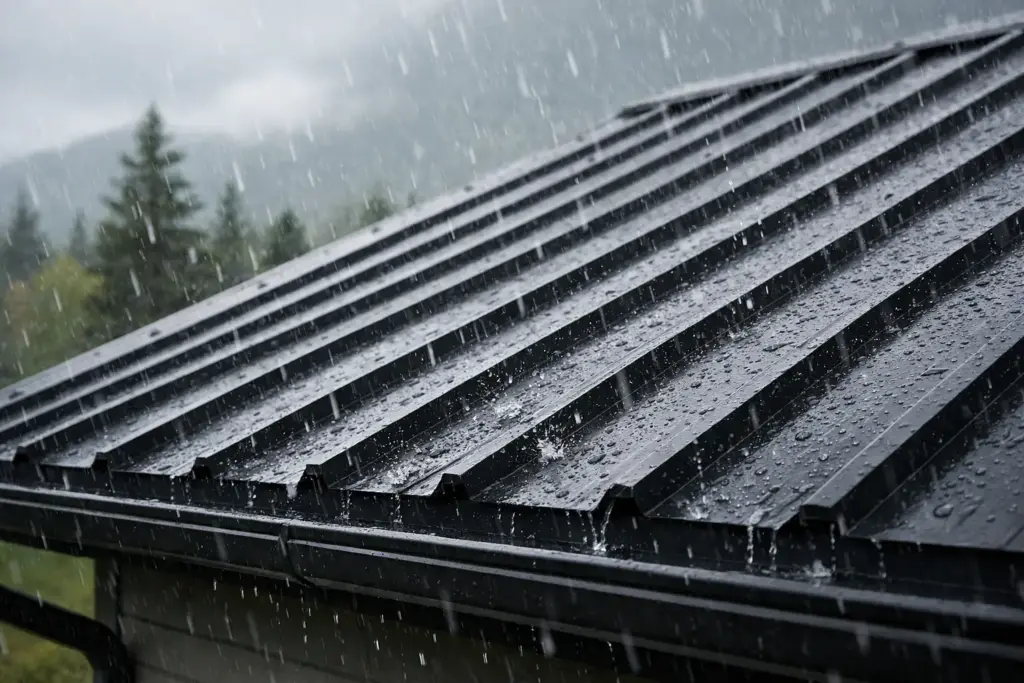
Rain on a metal roof is easy to picture: a hard, hollow drumming that makes conversation difficult. But are metal roofs noisy in rain once installed on a properly built Alberta home? In most cases, no. A modern metal roof installed over a complete roof assembly is typically no louder indoors than asphalt shingles, and sometimes the difference is difficult to notice at all.
The old perception comes largely from barns, sheds, cabins, and older buildings where metal panels were installed directly over open framing with little or no insulation. That is not how a premium residential roofing system is built. The sound you hear inside a home depends far more on the layers beneath the roofing than on the metal itself.
Why metal roof rain noise gets misunderstood
A metal roof surface does transmit the impact of raindrops differently than an asphalt shingle. Metal is a dense, smooth material, so rain can create a sharper sound at the exterior surface. On an exposed structure, that sound is obvious.
A finished home, however, has a roof deck, underlayment, attic space or insulated roof cavity, insulation, vapour control layers, drywall, and interior finishes between the roof and the living area. Each layer reduces and disperses sound. By the time rain noise reaches a bedroom, great room, or upper floor office, the roofing material alone is no longer the deciding factor.
This distinction matters for acreage homes and custom builds, where vaulted ceilings, open-concept spaces, and large roof planes can change how sound travels. The right roof design should account for the full assembly, not simply the panel chosen for the exterior.
Are metal roofs noisy in rain on a well-built home?
On a conventional insulated attic, a correctly installed metal roof should not create disruptive rain noise indoors. Fibreglass, cellulose, mineral wool, and spray foam insulation all help dampen airborne sound. A finished ceiling adds another effective barrier.
The experience can be different in a cathedral ceiling or low-slope roof assembly, where there is less open attic space between the roof deck and interior finish. Even then, noise control is manageable when the assembly is designed properly. Adequate insulation, a solid deck, quality underlayment, and carefully detailed ventilation all contribute to a quieter result.
Heavy rain and hail are separate considerations. During an intense Alberta storm, any roof will be audible. Asphalt shingles, wood shakes, and metal all receive the same impact. Metal may produce a more distinct sound during peak rainfall, but that does not mean it will be excessively loud inside a properly insulated home.
For many homeowners, the real question is not whether they will hear rain at all. It is whether the sound will be intrusive. With a professionally designed residential roof system, it should not be.
The roof assembly controls the sound
A metal roof is not one layer of sheet metal. It is part of a system. The quality and configuration of that system determine both acoustic performance and long-term weather protection.
Solid decking provides a stable base
Most premium residential metal roofing is installed over solid roof decking, rather than directly over spaced purlins. The deck supports the roofing system and helps limit resonance. It also creates a more controlled base for underlayment and fastening.
An exposed agricultural building is different. When panels span open framing, the metal can vibrate more freely and the interior is directly exposed to the sound. Comparing that construction to a finished home is not an accurate comparison.
Underlayment adds another sound layer
High-quality underlayment is primarily selected for water management and roof protection, but it also creates a buffer between metal panels and the deck. Depending on the system, installers may use specialized membranes that improve separation, drainage, and sound dampening.
The correct underlayment depends on roof slope, panel profile, ventilation approach, and local climate conditions. It should never be treated as an optional hidden layer. In Alberta, where freeze-thaw cycles and wind-driven moisture place real demands on a roof, it is a core part of the installation.
Insulation does the heavy lifting indoors
Insulation is the most significant sound-control component for the rooms below. A well-insulated attic or roof cavity reduces heat loss, improves comfort, and limits outside noise from rain, wind, traffic, and aircraft.
This is one reason roof sound cannot be evaluated separately from the building envelope. A home with inadequate insulation may feel louder under any roof type and will also be less efficient to heat through an Alberta winter.
Ceiling design changes the result
Standard drywall ceilings provide meaningful acoustic separation. Homes with exposed timber framing, open vaulted interiors, or thin ceiling assemblies require more deliberate planning. These architectural features can still work exceptionally well with metal roofing, but the roof and ceiling details need to be selected together.
For a custom build, this is best addressed before construction begins. Retrofitting sound control after the ceiling is complete is possible, but it is rarely as efficient or as clean as designing it into the original assembly.
Installation quality matters as much as material choice
Noise concerns are sometimes really installation concerns. A poorly installed metal roof can develop movement, loose flashing, or poorly secured components that rattle in strong wind. That is not normal metal roof behaviour. It is a workmanship issue.
Standing seam systems, metal tiles, and metal shingles each have specific fastening and expansion requirements. Metal expands and contracts as temperatures change, particularly during Alberta’s sharp swings between winter cold and summer heat. A proper installation allows for controlled movement without loose panels, stress at fasteners, or unwanted noise.
Attention to details around valleys, penetrations, wall transitions, ridge caps, and eaves also matters. These areas must be secured correctly while still allowing the roofing system to perform as designed. Precision installation protects against water entry, wind uplift, and avoidable sound issues.
Rain noise versus wind noise
Rain is only one part of the conversation in Alberta. On exposed acreages and elevated properties, wind can be more noticeable than rainfall. A premium metal roof should be engineered and installed to resist uplift and prevent panel movement under normal wind conditions.
If you hear persistent clicking, rattling, or flapping during moderate winds, that deserves an inspection. A roof should not sound loose. Wind noise can point to an issue with panel engagement, flashing, trim, fasteners, or nearby components such as gutters and soffits.
A quiet roof is not the primary reason to choose metal, but it is one indicator of a system that has been installed with discipline.
When a metal roof may sound louder
There are situations where rain sound can be more noticeable. An uninsulated garage, workshop, porch roof, detached outbuilding, or covered patio with exposed framing will naturally carry more sound. Some homeowners enjoy that crisp rain sound in a seasonal space. Others may prefer insulation or a finished ceiling below the metal.
A metal roof installed directly over an existing roof can also perform differently depending on the layers below, the condition of the original roof, and the method used. Overlay installations require careful evaluation. They are not automatically the best choice for every property, particularly where long-term detailing, ventilation, or deck condition is a concern.
The panel profile may affect the exterior sound character slightly, but it is usually less important than the assembly beneath it. Selecting a roof based solely on a belief that one metal profile will be dramatically quieter than another misses the larger construction question.
The long-term value is larger than rain noise
For high-value residential properties, a roofing decision should be based on performance over decades. Metal roofing offers strong resistance to wind, snow shedding, fire exposure, and repeated freeze-thaw cycles when the correct system is selected and installed properly. It can also support a cleaner architectural finish than many short-lifecycle roof products.
There are trade-offs. Metal roofing has a higher upfront investment, and the details must be executed by installers who understand the specific system. Snow retention may be required over entrances, walkways, decks, and mechanical equipment. Flashing details must be designed around the roof, not improvised on site.
Those requirements are part of doing the work correctly. A premium roof is not simply metal panels on a house. It is a coordinated exterior system built for the structure, the climate, and the property owner’s long-term expectations.
A well-built metal roof lets you hear a heavy Alberta rain when the house is quiet, not because the roof is failing to control sound, but because weather is happening outside where it belongs. The more valuable question is whether the full assembly has been designed to protect the home for the long run.