
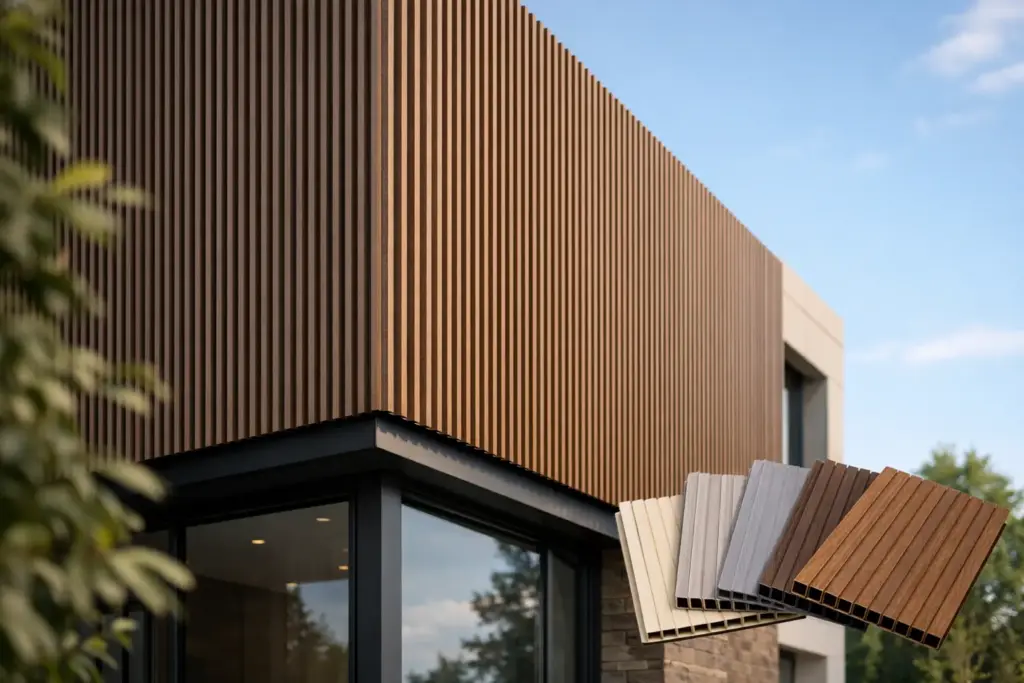
The wrong exterior cladding usually does not fail all at once. It starts with movement at the joints, fading on the sun-heavy elevations, moisture problems where details were rushed, or a finish that looked current for two years and dated by year five. A fluted composite board facade appeals to a different type of property owner – one who wants architectural definition, lower upkeep, and a cleaner long-term result.
For custom homes, acreage properties, and premium residential builds in Alberta, facade materials need to do more than look good on possession day. They need to hold their shape through freeze-thaw cycles, resist weather exposure, and continue to support the value of the property over time. That is where fluted composite boards have become a serious option.
What a fluted composite board facade does well
The appeal starts with the profile. Fluted boards create a controlled shadow line across the wall surface, which adds depth without relying on overly decorative trim or mixed materials that can feel busy. On modern homes, the result is sharp and architectural. On transitional designs, it can add texture while keeping the exterior restrained.
Composite construction changes the maintenance equation. Compared with some natural wood claddings, the goal is not constant refinishing or ongoing correction as the material ages. Property owners looking at lifecycle performance often see the value here quickly. A premium exterior should not demand frequent cosmetic work just to stay presentable.
That said, appearance is only part of the decision. The better reason to choose this system is consistency. A properly specified fluted composite board facade offers a more stable and predictable finish than many traditional alternatives, especially on projects where long walls, exposed elevations, and architectural cleanliness matter.
Why this material suits Alberta conditions
Alberta is hard on building exteriors. High UV exposure, strong wind, sudden temperature swings, and winter moisture all put pressure on facade materials and the details behind them. Any product can look convincing in a showroom. The real test is how it performs after several seasons on an exposed site.
This is where material stability and installation quality matter just as much as design. Composite boards are selected in part because they are engineered for durability and lower maintenance. When paired with proper substructure, ventilation, fastening, and trim detailing, they can perform very well in demanding climates.
There is still an important qualifier – not every composite system performs the same way. Board density, finish quality, manufacturer tolerances, fastening requirements, and expansion allowances all affect the final result. The product category is strong, but the specific system and the installer’s discipline determine whether it stays that way.
Fluted composite board facade vs traditional wood
Wood has undeniable warmth. On the right house, with the right owner, it can be a beautiful choice. But it asks more from the building and from the person maintaining it. Alberta weather does not treat wood gently, especially on sun-exposed or wind-driven elevations.
A fluted composite board facade is often chosen by owners who want the texture and rhythm of a premium cladding profile without committing to the refinishing cycle that wood can require. That makes it attractive for busy homeowners, rural properties, second residences, and investment-minded owners who care about appearance but also want predictable upkeep.
The trade-off is straightforward. If someone wants the exact character, grain variation, and ageing behaviour of real wood, composite will not replace that experience completely. But if the priority is a controlled architectural look with fewer maintenance demands, composite often makes more sense.
Design value beyond the material itself
Good exterior design is rarely about a single product. It comes from proportion, contrast, alignment, and restraint. Fluted boards work best when they are part of a disciplined exterior composition rather than an attempt to make an average elevation feel expensive through texture alone.
Used correctly, they can strengthen entry features, accent upper volumes, define recessed walls, or break up broad surfaces with more refinement than standard lap siding. They also pair well with premium metal roofing because both materials favour clean geometry, strong lines, and long-term visual consistency.
This matters for higher-value homes because buyers notice when an exterior has been designed as a system. Roof, facade, soffits, flashing, and trims should speak the same language. When they do, the home feels more resolved and more durable.
Where installation makes or breaks the result
Facade products are often judged by their face value, but the hidden work behind them is what determines whether the assembly performs. This is especially true with fluted profiles, where alignment, fastening, spacing, and edge treatment are visible. Small errors do not stay small.
The wall assembly has to account for moisture management, ventilation strategy, fastening method, movement allowances, and substrate condition. Board layout also matters. If the pattern is inconsistent around windows, corners, and transitions, the exterior can lose the precision that made the material appealing in the first place.
For that reason, premium facades should not be treated like a commodity siding install. They require planning before boards go on the wall. That includes elevation review, detail coordination, and a clear understanding of how the facade meets roofing lines, parapets, trims, and penetrations.
At Hazinasky Roofing LTD., that kind of coordination matters because the best exterior projects are not built as separate trades solving separate problems. They are built as one envelope strategy.
Is it a good fit for every home?
No, and that is worth saying clearly.
A fluted composite board facade makes the most sense on homes where architecture matters enough to justify a premium exterior decision. On custom builds, modern acreages, infill properties, and high-value renovations, it can add meaningful design value while keeping maintenance demands under control. On a basic house with minimal detailing and a cost-first budget, it may be the wrong product.
There is also the question of scale. Large wall areas can make the profile look impressive and intentional. On very small applications, the effect can feel less significant unless the detailing is carefully handled. The best results come when the material is selected early, not added late as a decorative upgrade.
Budget should be weighed properly as well. Upfront cost may be higher than standard cladding options, but that comparison is incomplete if it ignores maintenance, repainting, refinishing, repair frequency, and the effect on long-term curb appeal. Premium exteriors should be judged over years, not only at installation.
What to look for before you commit
Start with the wall assembly, not the colour sample. Ask how the boards will be installed, how movement is handled, how corners and openings are detailed, and what the ventilation approach is behind the facade. If those answers are vague, the project is not ready.
Then review the profile in the context of the whole exterior. The board can look excellent on its own and still feel out of place if the roofline, trims, or material transitions are not designed to support it. This is especially relevant on premium homes, where inconsistency is easier to spot.
Finally, think about the property ten years from now. Will the facade still match the level of the home? Will it still feel current? Will the maintenance plan make sense for the owner? Those questions usually lead to better decisions than focusing only on initial cost or showroom appearance.
A practical choice for long-term exteriors
The best cladding decisions are usually the ones that balance design discipline with real-world performance. A fluted composite board facade can do exactly that when the product is well selected and the installation is handled with precision. It brings depth, order, and a premium finish to the exterior, but its real value is in staying credible after years of weather exposure.
For Alberta homeowners and builders who are thinking beyond short-cycle materials, that is the point. The exterior should not just impress at handover. It should continue to look deliberate, perform reliably, and support the property the way a capital investment should.
One Response