
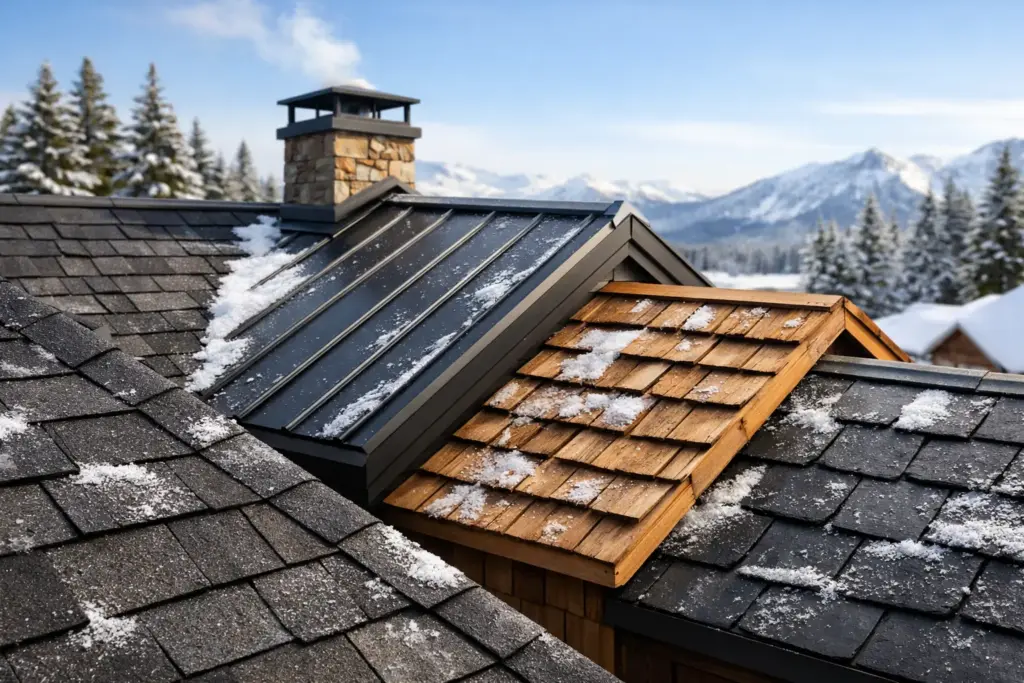
A roof in Alberta does not get judged on curb appeal alone. It gets judged in January, under a heavy snow load, after a chinook, during freeze-thaw cycles, and in the wind that finds every weak detail. That is why choosing the best roofing materials cold climates demand is less about trend and more about long-term performance.
For higher-value homes, acreage properties, and custom builds, the right answer usually comes down to how well a roofing system handles snow shedding, ice management, thermal movement, wind uplift, and service life. Cost matters, but replacement cycles, repair frequency, and architectural fit matter just as much. A cheaper roof that fails early is not cheaper.
What cold-climate roofing really needs to do
Cold climates punish roofs in a few predictable ways. Snow adds weight. Ice dams force water backward under vulnerable details. Freeze-thaw movement tests fasteners, seams, sealants, and flashing. Strong winds expose installation shortcuts quickly. Then there is sunlight and temperature swing – one day deeply cold, the next warming enough to create meltwater.
A good roof for these conditions needs more than surface toughness. It needs a system approach. Material choice matters, but so do underlayments, ventilation, edge detailing, flashing design, fastening method, and installer experience. When owners compare products without looking at execution, they often miss the factor that decides whether the roof performs for decades or becomes a maintenance problem.
Best roofing materials cold climates homeowners should compare
Not every roofing material performs equally once snow, ice, and temperature extremes are part of the equation. Some can work. A smaller group works exceptionally well.
Metal roofing
For demanding Canadian conditions, metal roofing is often the strongest long-term option. Standing seam metal, metal shingles, and premium metal tile systems are built for durability, low maintenance, and excellent weather resistance. They are especially well suited to homes where lifecycle value matters more than lowest upfront cost.
Metal performs well in cold climates for several reasons. It sheds snow more effectively than many rougher-surface materials, which can reduce prolonged snow loading when the roof is properly designed. It resists moisture absorption, so freeze-thaw damage is far less of a concern than with porous materials. High-quality metal systems also handle wind very well when specified and installed correctly.
That said, metal is not a single category. Exposed-fastener panels are very different from premium concealed-fastener systems. For custom homes and long-term ownership, standing seam is usually the better fit because it allows for thermal movement, has cleaner lines, and avoids many of the maintenance points associated with exposed screws and washers. European-style metal tiles and metal shingles can also be excellent choices when the goal is to combine architectural character with cold-weather durability.
The trade-off is upfront investment. Premium metal roofing costs more than asphalt. But on a high-value property, the longer service life, stronger resistance to climate stress, and lower likelihood of frequent repairs often make the math work better over time.
Asphalt shingles
Asphalt shingles remain common because they are accessible, familiar, and less expensive upfront. In cold climates, a quality architectural shingle can perform reasonably well, particularly on standard residential builds where budget drives the decision.
Still, asphalt has limits. It is more vulnerable to wind damage than properly installed metal systems, and it does not shed snow as efficiently. Repeated freeze-thaw cycles can shorten lifespan over time, especially if attic ventilation is poor or ice damming is a recurring issue. Granule loss, cracking, and storm-related repairs are not unusual as the roof ages.
For owners planning a shorter hold period, asphalt may be acceptable. For acreage homes, custom builds, or properties where appearance and long-term maintenance costs matter, it often becomes the compromise option rather than the best one.
Slate and synthetic slate
Natural slate has excellent longevity and strong cold-weather durability, but it comes with serious structural and cost considerations. It is heavy, expensive, and highly dependent on specialized installation. On the right home, it can be exceptional. On many projects in Alberta, it is simply not the most practical answer.
Synthetic slate is lighter and can offer a similar visual effect, but quality varies widely between manufacturers. Some products perform well. Others do not age as gracefully under UV exposure and temperature swing. This is one of those categories where product selection needs to be very disciplined.
Cedar shakes and wood roofing
Wood roofing has aesthetic appeal, especially on certain architectural styles, but it is rarely the strongest recommendation for harsh cold climates where snow, moisture, and maintenance exposure are serious concerns. Wood can be vulnerable to moisture retention, weathering, and more frequent upkeep. For premium homes where owners want natural warmth in the exterior palette, there are often better-performing roofing choices and better places to express wood visually.
Why metal often leads the list
When clients ask about the best roofing materials for cold climates, the conversation often returns to premium metal because it solves several problems at once. It offers long service life, strong resistance to snow and ice exposure, excellent wind performance, and a refined architectural appearance that suits modern and traditional homes alike.
It also supports better long-term planning. Owners are not just buying a roof surface. They are reducing the likelihood of premature replacement, repeated repairs, and visual decline. On large roof planes, acreage homes, and exposed sites, that matters.
There is also a design advantage. Premium metal systems look intentional. Clean panel lines, controlled detailing, and purpose-built trim work suit custom construction far better than roofing that looks purely commodity-driven. For builders and investors working in the upper residential market, that contributes to property value.
Installation quality matters as much as the material
A cold-climate roof fails at details before it fails at the field. Valleys, penetrations, eaves, ridges, transitions, and flashing conditions are where weak execution gets exposed. Even the best product can underperform if it is installed without proper planning for snow load, ice control, ventilation, and movement.
This is especially true with metal. Premium systems require precision. Panel layout, clip spacing, substrate preparation, underlayment specification, and flashing fabrication all affect performance. A roof should not just look clean on completion. It should be built to stay watertight and stable through years of seasonal stress.
That is why specialist installation matters. A contractor who treats premium roofing as a system rather than a commodity is far more likely to deliver the result the material is capable of.
The right choice depends on the property
There is no single roof that fits every project. A modest suburban home with a shorter ownership horizon may justify architectural asphalt. A luxury acreage home exposed to wind and drifting snow usually justifies something stronger and longer-lasting. A custom build with clean modern lines may be best served by standing seam. A traditional home may suit metal shingles or tile-profile metal better.
Budget should be part of the decision, but not the only part. Owners should also weigh service life, maintenance exposure, aesthetic fit, structural considerations, and the real cost of replacement cycles. Roofing is a capital decision. It should be evaluated that way.
For Alberta properties, that usually means asking a simple question: do you want to revisit this roof sooner than necessary, or install a system designed to handle the climate properly from the start? Companies such as Hazinasky Roofing LTD. work in that second category, where the priority is not minimum entry cost but long-term performance and clean execution.
Best roofing materials cold climates demand in Alberta
If the goal is to narrow the field honestly, premium metal roofing stands at the top for many Alberta projects. It offers the best balance of durability, weather resistance, lifecycle value, and architectural quality. Asphalt remains common, but it is often chosen because it is cheaper upfront, not because it performs better over decades. Slate can be excellent but is practical for a narrower range of homes. Wood roofing is usually harder to justify once maintenance and moisture risk are considered.
The best choice is the one that matches the climate, the structure, and the standard of the property. On homes where longevity, appearance, and predictable performance matter, premium metal is often the material that makes the most sense.
A roof should not be selected for how it looks on quote day. It should be selected for how it performs after years of snow, wind, ice, and temperature swing. That is the standard worth building to.