
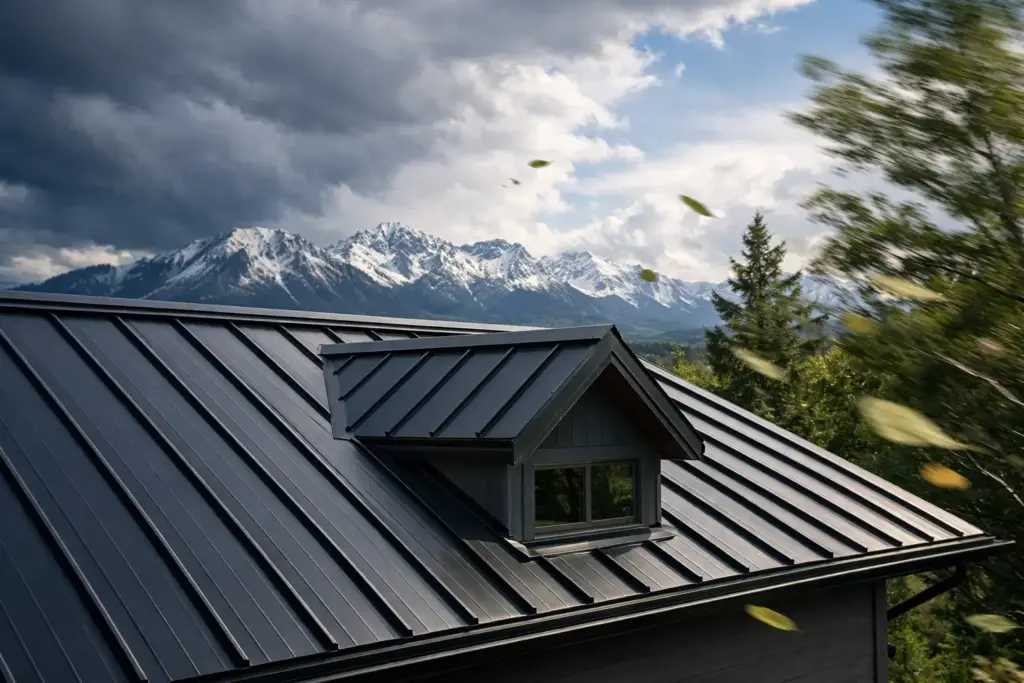
A roof usually does not fail all at once. In Alberta, wind starts by testing the edges, lifting weak flashings, prying at ridge details, and working under panels or shingles until a small weakness becomes a costly problem. That is why a metal roof for high winds is not just a material choice. It is a system choice, and the difference shows up when weather turns aggressive.
For acreage homes, custom builds, and higher-value properties, wind resistance has to be treated as part of the building envelope, not as a line item picked on price alone. A roof that looks clean but is detailed poorly will not hold up the way an owner expects. A properly specified metal system, installed with discipline, gives you a far better chance of long-term performance under repeated wind exposure.
Why a metal roof for high winds performs differently
The advantage of metal roofing in windy conditions comes down to engineering, attachment, and control. Many conventional roofing products rely on layered components that can loosen, crack, or lose bond strength over time. Metal systems are different. When properly designed, they use mechanical fastening, interlocking profiles, and continuous panel layouts that are inherently better suited to resisting uplift.
That does not mean every metal roof performs the same way. Wind performance depends on panel profile, substrate condition, fastening pattern, trim detailing, and how the roof transitions at eaves, hips, valleys, and penetrations. The material itself matters, but execution matters just as much.
Standing seam systems are often a strong fit where wind exposure is a serious concern. Their concealed fastener design protects critical attachment points from direct weather exposure, and the panel geometry can provide excellent uplift resistance when matched with the right clip system and deck assembly. Metal shingles and European-style metal tiles can also perform well, but they need precise layout and secure interlock at every course. A premium result depends on the full assembly, not just the panel selected from a brochure.
What wind actually attacks first
Most wind-related roof failures begin at vulnerable zones. Perimeters and corners experience higher uplift pressure than the centre field of the roof. That means edge metal, starter details, underlayment transitions, and fastening density become especially important. If these areas are underbuilt, wind will find them.
This is one reason lower-cost installations often disappoint. A roof can appear finished and still have weak points hidden in trim profiles, fastener spacing, or substrate preparation. On exposed sites outside the city, where open land allows gusts to build speed, those shortcuts show up quickly.
Homes on acreages often face a more demanding wind profile than sheltered suburban lots. Orientation, surrounding terrain, roof height, and even nearby outbuildings all affect pressure patterns. There is no single universal specification that suits every project. The right approach starts with understanding the property itself.
Choosing the right metal roof for high winds
If wind resistance is a priority, start by narrowing the field to systems with proven structural integrity and a track record in harsh climates. This is not the place to chase the cheapest gauge or the fastest install.
Standing seam is a common choice for good reason. Its clean lines suit custom architecture, and its concealed fastening reduces exposure at the most sensitive points. On many projects, it offers a strong balance of wind resistance, snow shedding, and long-term appearance. It is especially well suited to homeowners and builders who want a refined roof system without the visual clutter of exposed screws.
Metal tile and metal shingle systems can be an excellent option when the architectural goal calls for more texture or a more traditional look. Some profiles are engineered with strong lock geometry and can perform very well in wind. The key is to avoid assuming that all stamped or modular metal products are equal. Profile depth, fastening method, and accessory detailing vary widely.
The best system is usually the one that fits both the home and the exposure conditions. A low-slope roof, a steep custom roofline, and a large rural residence with multiple elevations may each require a different solution. Good specification is not about selling one profile for every project. It is about selecting the system that will perform properly on that building, in that location, over time.
Installation quality decides the outcome
A premium metal roof is only as good as the crew installing it. This is where many comparisons between roofing materials become misleading. Owners sometimes hear that metal lasts longer and resists wind better, then assume any installer can deliver that result. That is rarely true.
Metal roofing demands precision. Panel alignment, clip placement, fastening torque, substrate flatness, and trim fabrication all affect performance. Small errors can create noise, movement, water entry points, or uplift vulnerabilities. In high-wind conditions, small errors do not stay small.
The most reliable installations begin with a disciplined process. That means inspecting the deck, correcting uneven surfaces, using the proper underlayment assembly, and building edges and penetrations with the same care as the field panels. It also means respecting manufacturer specifications rather than improvising in the name of speed.
For higher-end residential work, craftsmanship also has a visual cost or benefit. Wind-resistant roofing should not look industrial or patched together. On a well-executed project, the strength is built into a clean, controlled finish. That matters on custom homes where the roof is one of the most visible architectural elements.
Alberta conditions add more than wind
A roof in Alberta does not only deal with gusts. It deals with snow load, freeze-thaw cycles, UV exposure, and abrupt temperature swings that can stress lower-grade materials and weak details. That makes system design even more important.
Metal performs well here because it handles temperature extremes without the same aging pattern seen in many shorter-lifecycle roofing products. It also sheds snow efficiently when the roof design allows for it, reducing the chance that trapped moisture or repeated ice buildup will compromise the assembly. But snow behaviour needs to be considered alongside wind behaviour. A roof designed to resist uplift still needs proper snow retention planning where entrances, walkways, or lower roofs are involved.
This is where premium specification pays off. A roofing system for Alberta should not be sold as a generic product. It should be tailored to local exposure and building use. Hazinasky Roofing LTD. works in exactly that space, where material quality and installation standards need to support long-term performance rather than short-term savings.
Cost, value, and the trade-off question
A metal roof typically costs more upfront than asphalt-based alternatives. That is the obvious trade-off, and it should be stated clearly. For some properties, especially those intended for short ownership periods or lower budget builds, that upfront premium may feel difficult to justify.
But on custom homes, acreage properties, and investment-grade residential assets, the better question is not initial price. It is lifecycle value. If a roof is expected to protect a high-value structure through years of wind, snow, and temperature stress, repeated replacement cycles are expensive. So are emergency repairs, interior water damage, disrupted occupancy, and the gradual loss of curb appeal.
A well-installed metal roof can reduce those long-term risks while supporting resale value and architectural consistency. It is a capital decision, not a cosmetic upgrade. Owners who understand that tend to make better roofing decisions.
What to ask before you commit
If you are considering a metal roof for high winds, ask direct questions. What wind conditions is the system designed for? Is the attachment concealed or exposed? How are eaves, ridges, valleys, and penetrations detailed? What substrate preparation is included? Who is responsible for fabricating and installing the flashings? Clear answers matter more than polished sales language.
You should also ask whether the proposed system fits your specific site. A home on open land west of a major centre may need a different approach than a sheltered infill build. Good roofing contractors do not generalize where exposure conditions differ.
A strong roof starts with realistic priorities. If wind resistance, long service life, and a cleaner architectural result matter to you, metal is worth serious consideration. The right system, installed properly, does more than survive storms. It protects the standard of the property underneath it.
When weather is part of the design brief, roofing should be chosen with the same discipline as structure, windows, and exterior cladding. That is how you avoid doing the job twice.
4 Responses