
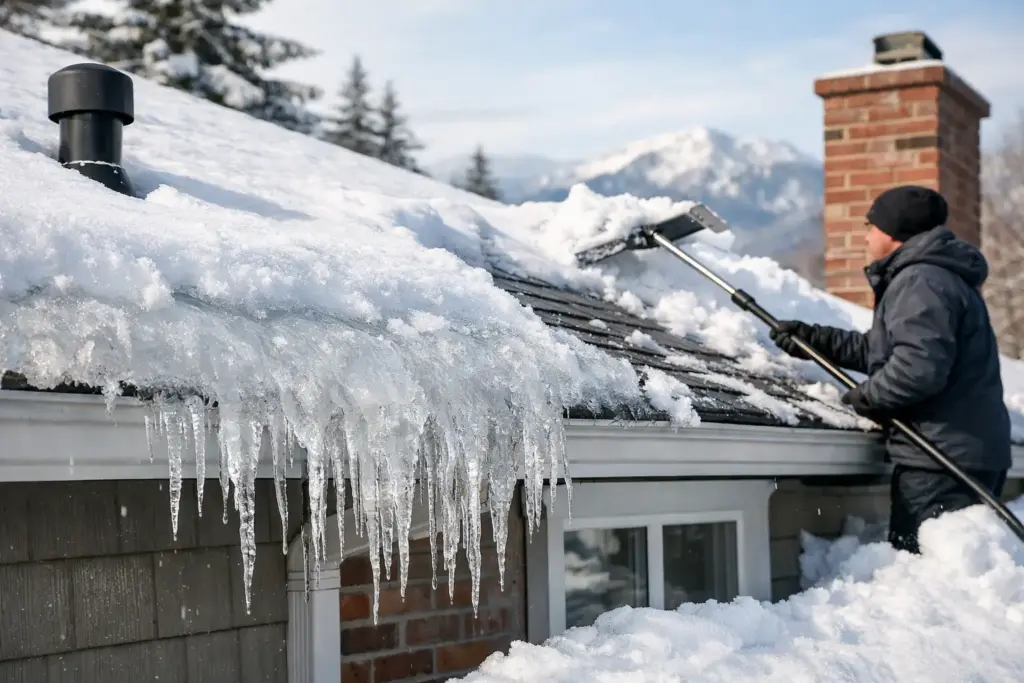
A roof can look perfectly sound in October and become a costly weak point after a few Alberta freeze-thaw cycles. Knowing how to prevent snow damming starts with understanding what is happening above and below the roof deck. The goal is not simply to make snow disappear. It is to manage heat, moisture, drainage, and snow movement so meltwater has a clear path off the building.
For acreage homes, custom builds, and high-value properties, this is a system issue. A premium roof covering performs best when insulation, ventilation, flashing, eaves, and snow-retention details are designed to work together.
What Snow Damming Means on a Roof
Snow damming is often used to describe a buildup of snow and ice that interrupts normal drainage. In many cases, the visible problem is an ice dam: heat escaping from the house melts snow higher on the roof, then the water refreezes at colder eaves. Over time, ice thickens, meltwater backs up behind it, and water can work beneath roofing materials or into wall and ceiling assemblies.
On metal roofs, snow movement is also part of the equation. A smooth metal surface sheds snow efficiently, which is a major advantage in Alberta. But large, heavy sheets of snow can release suddenly if the roof is not detailed with properly engineered snow retention. Conversely, poorly placed snow guards can hold snow where it should be released in a controlled manner, creating unnecessary loading and drainage concerns.
The right solution depends on the roof pitch, insulation level, attic configuration, exposure to sun and wind, roof geometry, and the type of roofing system installed.
Control Heat Loss Before It Reaches the Roof
Most ice-damming problems begin with uneven roof temperatures. When a heated interior warms the roof deck, snow melts even when outdoor temperatures remain below freezing. The meltwater flows downward until it reaches the unheated eave, where it freezes.
The first priority is a continuous thermal barrier. Insulation should be adequate for Alberta conditions and installed without gaps around attic hatches, recessed lighting, plumbing stacks, duct runs, and top plates. These small openings can release enough warm air to create localized melt channels on the roof.
Air sealing matters as much as insulation depth. Insulation slows heat movement, while air sealing stops warm, moist interior air from escaping into the attic. If either is incomplete, the roof may develop hot spots that lead to recurring ice buildup in the same location each winter.
This work is particularly relevant in older homes, additions, and custom homes with vaulted ceilings or complex rooflines. Those designs can be architecturally strong, but they require deliberate insulation and ventilation planning. A roof covering alone cannot compensate for heat loss from the building enclosure.
Watch for Early Warning Signs
Frost in the attic, dark staining near ceiling edges, uneven snow melt, and long icicles concentrated in one area are useful warning signs. Icicles are not always evidence of a serious issue, but heavy or recurring ice at the eaves deserves attention. It often indicates that warm air is reaching the roof deck or that drainage is restricted.
Build a Ventilated Roof Assembly
A cold roof deck is one of the most reliable ways to reduce ice dam formation. Effective attic ventilation helps keep the roof temperature closer to the outdoor temperature by carrying away excess heat and moisture.
A properly designed system typically brings air in at the soffits and releases it near the ridge. The airflow must be continuous. Blocked soffit vents, compressed insulation at the eaves, undersized ridge ventilation, or isolated attic compartments can interrupt that path and leave parts of the roof warmer than others.
Ventilation is not a substitute for air sealing. It cannot solve major heat loss from the living space below. It is the supporting part of a complete assembly: first limit heat and moisture entering the attic, then provide a clear route for remaining heat and moisture to exit.
Low-slope transitions, cathedral ceilings, dormers, and roof valleys need special attention. These areas may require dedicated ventilation channels or an engineered unvented assembly. The correct approach depends on the building design. Applying one standard vent detail to every roof is how hidden moisture problems begin.
Design Eaves and Drainage for Freeze-Thaw Conditions
Snow damming becomes destructive when meltwater cannot leave the roof safely. Eavestroughs, downspouts, valleys, drip edges, and flashing details all need to accommodate winter conditions, not just summer rain.
Keep eavestroughs clear before snowfall. Leaves, roofing debris, and sediment can freeze into a blockage that traps water at the roof edge. Confirm that downspouts discharge well away from the foundation and remain open through winter. In areas with persistent freezing, heated cable may be considered for specific drainage points, but it should not be treated as the primary cure for an under-insulated or poorly ventilated roof.
Roof geometry also affects drainage. Long valleys, shallow pitches, and intersections where one roof plane sheds onto another collect more snow and water. These locations require durable underlayment, precise flashing, and detailing that accounts for concentrated flow. On premium homes, this is where installation discipline makes a measurable difference over the life of the roof.
Use Snow Retention Properly on Metal Roofs
Metal roofing is well suited to Alberta because it resists wind, sheds water quickly, and has a long service life when correctly installed. Its snow-shedding ability, however, must be managed where people, entrances, decks, lower roof sections, and mechanical equipment are below.
Snow guards or rail-style snow-retention systems hold snow in a controlled pattern so it can melt gradually rather than releasing as a sudden slide. They should be selected for the roof profile, pitch, snow load, panel layout, and attachment method. On standing seam systems, non-penetrating clamp-mounted retention is often preferred because it avoids unnecessary holes through the roof panels.
The trade-off is straightforward: retaining snow adds weight to the roof and can increase the volume of meltwater held on the surface. That is why snow retention must be designed, not added randomly after the fact. The layout should preserve drainage paths, avoid overloading isolated areas, and direct snow management away from vulnerable locations.
Do not rely on improvised guards, screws driven through metal panels, or partial installations that stop short of the areas they are intended to protect. A premium roof system depends on compatible components and precise attachment.
Remove Excess Snow Safely
After an exceptional snowfall, removing snow may reduce loading and lower the likelihood of damming. It must be done carefully. Scraping directly against roofing can damage protective finishes, flashings, sealants, and metal panels. Chipping at ice with sharp tools can create a far more expensive problem than the ice itself.
From the ground, a roof rake with a non-abrasive edge can remove the lower portion of snow where it is safe to do so. Leave a thin layer above the roofing surface rather than pulling the tool down to bare metal. Never work beneath an overhanging snow mass, and do not climb onto an icy roof without the proper equipment and fall protection.
Professional removal is the better choice when ice is heavy, roof access is difficult, snow has accumulated in valleys, or there are signs of water infiltration. Steam-based ice removal can be appropriate in some cases because it addresses ice without the mechanical damage caused by chisels and axes.
Avoid Quick Fixes That Create Bigger Problems
Salt, aggressive chemicals, and makeshift channels may appear to solve an ice dam, but they can corrode metal components, damage finishes, stain exterior materials, and harm landscaping. Heated cables installed without a drainage strategy can create meltwater that simply refreezes farther down the roof.
Likewise, replacing shingles or adding a metal roof without investigating insulation and attic conditions may only conceal the underlying cause. A new roof should be part of a properly coordinated exterior system, especially on homes where performance and long-term property value matter.
When to Bring in a Roofing Specialist
A professional assessment is warranted when dams return every winter, interior leaks appear, attic frost is present, or snow releases unpredictably from a metal roof. The review should consider the roof covering, but also the ventilation path, insulation continuity, flashing, eaves, structural loading, and snow-retention layout.
For a new build or major replacement, these decisions are best made before installation begins. Hazinasky Roofing LTD. approaches premium metal roofing as a complete exterior assembly, because long-term performance depends on more than the visible panels.
A roof that handles Alberta snow well is rarely the result of one product or one quick repair. It is the result of controlled heat loss, clear drainage, and installation details that respect the way winter actually behaves.
3 Responses