
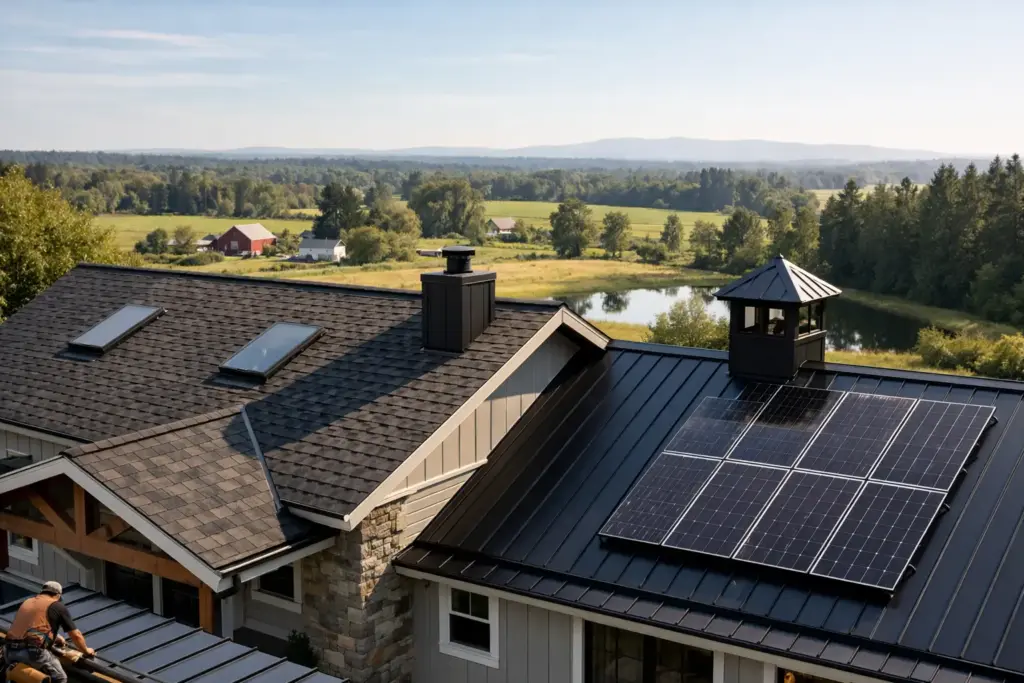
Acreage roofs work harder than roofs in town. They face open-country wind, deep snow loads, longer sun exposure, and often fewer nearby trees or buildings to break the weather. The best roofing upgrades for acreage are the ones that protect the entire building envelope while reducing the maintenance cycle that can become expensive and inconvenient outside the city.
For a custom home, rural estate, or investment property, roofing should not be treated as a cosmetic finish. It is a long-term capital decision. The right system protects the structure, supports the home’s architectural value, and performs predictably through Alberta winters and temperature swings.
Start With a Metal Roofing System Built for Alberta
A premium metal roof is often the most meaningful upgrade an acreage owner can make. Unlike conventional asphalt shingles, which can lose granules, curl, crack, or lift over time, a properly specified and installed metal system is designed for a far longer service life.
Standing seam metal roofing is particularly well suited to modern acreage homes. Its continuous vertical panels and concealed fasteners create a clean architectural profile with fewer exposed points of failure. The system sheds snow efficiently, resists wind uplift when installed correctly, and gives a contemporary custom build the disciplined finish it deserves.
European-style metal tiles and metal shingles are also strong choices where the home calls for more texture or a traditional roof profile. They deliver the durability advantages of metal while complementing estate homes, country residences, and designs that would not suit a flat-panel standing seam look.
Material selection still depends on the roof design. A low-slope roof, steep gable, complex valley layout, or roof with many dormers each requires a different approach. The best-looking panel is not automatically the best-performing system if its profile, flashing details, or drainage plan do not match the architecture.
Choose the Right Metal Profile for the Home
The best roofing upgrades for acreage properties should improve both performance and curb appeal. On larger lots, the home is usually visible from a longer approach, which makes the roofline a major part of the property’s overall impression.
Standing seam works well on clean-lined contemporary homes, modern farmhouses, and custom builds with simple, strong roof geometry. Its restrained appearance allows the proportions of the building to stand out. Dark charcoal, black, deep bronze, and natural metallic finishes can all work well, but colour should be chosen in relation to the façade, window frames, masonry, and surrounding landscape.
Metal tiles can bring more dimension to homes with steeper pitches, complex forms, or a more classic design language. They offer a refined alternative to heavy concrete tile or short-lifecycle asphalt products. Metal shingles can provide another architectural option where a textured, traditional appearance is desired without accepting the maintenance demands of wood shake.
Do not select a profile based only on a sample board. Review the roof slope, the visibility of seams or tile courses from the driveway, and how snow will move across the surface. A roofing system should look intentional from every major viewing angle, not merely attractive in a showroom.
Upgrade the Details That Usually Cause Leaks
Many roof failures do not begin in the field of the roof. They begin at transitions: valleys, chimneys, skylights, sidewalls, penetrations, and eaves. On an acreage home, access for emergency repairs may be less convenient, so these details deserve more attention during the initial installation.
High-quality flashing, correctly integrated underlayment, and disciplined water management are essential. Flashing should direct water out and away from the assembly, not depend on sealant as the primary defence. Sealants have a role, but they age. Properly formed metal details and correctly layered membranes do the lasting work.
Valleys require particular care because they collect water, snow, debris, and ice. A complex roof with multiple valleys can be visually impressive, but it also creates more areas that demand precise installation. In some cases, simplifying the roof geometry during a renovation or new build can improve long-term reliability as much as changing the roofing material.
A professional installation also accounts for thermal movement. Metal expands and contracts with Alberta’s temperature changes. Panels, clips, fasteners, and trims must be installed as a complete system that allows for movement where required. This is one reason premium metal roofing is not a material to treat as a generic replacement job.
Plan for Snow Management, Not Just Snow Shedding
Metal roofs shed snow well, which is a major advantage in Alberta. However, snow shedding needs to be controlled near entrances, lower roof sections, decks, walkways, mechanical equipment, and landscaping features. A large release of snow can damage gutters or create a safety issue if no plan is in place.
Snow retention systems can be installed strategically to hold snow in controlled areas and release it gradually. The correct layout depends on roof pitch, panel profile, exposure, and what sits below the eave. Snow guards should be engineered for the roof system and installed in a way that protects the panels rather than creating weak points.
Eavestroughs and downspouts should also be assessed as part of the roofing upgrade. An undersized or poorly supported drainage system can be overwhelmed during rapid melt periods. On acreage properties, directing runoff away from foundations, driveways, and high-traffic paths is just as important as moving it off the roof.
Improve Ventilation and Insulation at the Same Time
A new roof is the right time to evaluate what is happening below the roof deck. Poor attic ventilation and inconsistent insulation can contribute to ice damming, condensation, heat loss, and premature material wear. Installing premium metal over an unresolved attic problem does not correct the underlying issue.
A balanced ventilation strategy helps manage moisture and temperature in the attic space. The exact design depends on the home’s roof shape, insulation depth, ceiling air sealing, and whether the attic is vented or conditioned. There is no single vent product that solves every roof, especially on custom homes with complicated layouts.
Air sealing is equally important. Warm interior air leaking into an attic can create condensation when it meets cold surfaces. Over time, that moisture can affect framing, sheathing, insulation, and indoor air quality. Before the new roofing system is installed, identify and correct obvious air leakage paths around plumbing stacks, electrical penetrations, attic hatches, and mechanical openings.
Add Exterior Upgrades That Complete the Design
For acreage homes, the roof rarely stands alone. A premium roofing project can be an opportunity to bring the exterior into a more cohesive architectural system. Fluted composite board façades, carefully selected soffit materials, refined fascia, and matching metal accents can give a custom home a more complete finish.
The goal is not to add features for their own sake. It is to create continuity between the roof, walls, openings, and entry areas. A strong exterior palette uses fewer materials well, with clean transitions and durable components in the areas most exposed to weather.
This approach can be especially valuable for older acreage homes that have good structure but an uneven exterior appearance. Replacing a tired roof while improving selected façade elements can materially change how the property presents from the road and how it holds value over time.
Put Installation Quality Ahead of the Lowest Quote
Premium materials only perform as intended when the installation is precise. Comparing quotes solely by price can overlook major differences in panel specification, underlayment, flashing scope, ventilation work, trim details, removal requirements, and warranty coverage.
Ask how the contractor will handle transitions, snow retention, penetrations, ventilation, and thermal movement. Confirm whether the quoted system is designed for the roof rather than assembled from generic components. For high-value properties, the scope should be clear enough that there are no surprises once the old roof comes off.
Hazinasky Roofing LTD. approaches acreage roofing as a complete exterior system, with the material, details, and installation standard working together. That is the difference between a roof that simply looks new and one built to perform for decades.
The most useful next step is to assess the property before a failure forces the timeline. Walk the exterior after a storm, look for staining at eaves and ceilings, note drifting snow zones, and consider where water and snow travel around the home. A well-planned roofing upgrade gives an acreage property the protection and finish quality it should have from the start.