
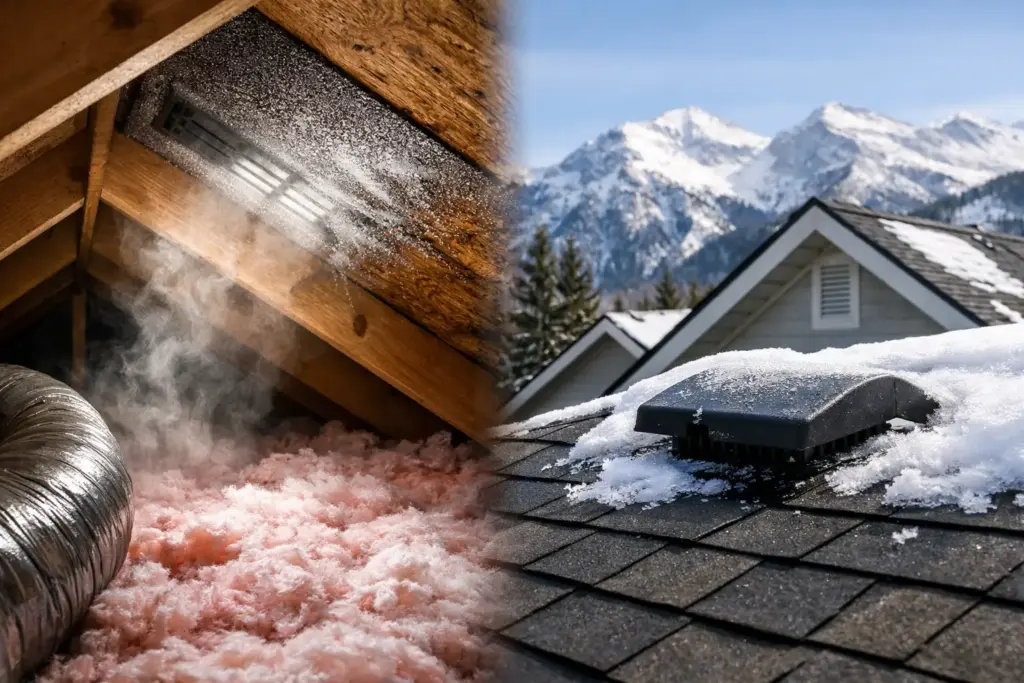
A roof can look flawless from the street while moisture quietly builds beneath it. Attic ventilation problems often begin out of sight, then show up as condensation, ice dams, premature roof wear, stained ceilings, or insulation that no longer performs as intended. For Alberta homes, where winter cold and rapid temperature swings are part of the building environment, the attic must be treated as a controlled system, not unused space beneath the roof.
A premium roof system is designed to protect the home for decades. That performance depends on correct detailing above and below the roof deck, including ventilation, insulation, air sealing, and drainage. When one part is overlooked, the entire assembly carries more risk.
Why attic ventilation matters in Alberta
Warm indoor air naturally rises. In winter, that air can carry significant moisture from cooking, showers, laundry, humidifiers, and daily living. If it escapes through gaps around pot lights, attic hatches, plumbing penetrations, or unsealed framing, it enters the attic and meets cold roof sheathing.
The result can be condensation or frost on the underside of the roof deck. When temperatures rise, frost melts and may be mistaken for a roof leak. Over time, repeated wetting can damage insulation, encourage mould growth, stain ceilings, and deteriorate wood components.
Ventilation helps remove heat and moisture from the attic, but it is not a substitute for air sealing. This distinction matters. Adding more roof vents to an attic that leaks warm, moist indoor air may improve airflow, yet it will not fully solve the source of the moisture. The right approach addresses both the air entering the attic and the route it has to leave.
The warning signs homeowners should not ignore
Many attic issues become visible only after several winter cycles. A focused inspection is particularly worthwhile after extended cold weather or a major snowfall.
Look for damp or compressed insulation, darkened roof sheathing, rusty nail tips, frost on framing, a musty attic smell, or water marks near ceiling fixtures and exterior walls. In occupied areas, peeling paint, ceiling stains, and rooms that feel unusually cold can also point to air leakage and attic moisture.
Ice dams are another common signal. They form when heat escaping from the home warms the upper roof surface, melting snow. Water runs down toward the colder eaves, refreezes, and creates a ridge of ice. The ice itself is not always proof of poor ventilation, but persistent or severe ice damming usually indicates a combination of heat loss, inadequate air sealing, insulation gaps, and restricted attic airflow.
During summer, an overheated attic can place unnecessary stress on roofing materials and make upper floors harder to cool. Metal roofing performs exceptionally well in Alberta conditions, but it still requires a properly designed assembly. A high-performance roof covering cannot compensate for poor attic detailing beneath it.
Common causes of attic ventilation problems
Intake and exhaust are out of balance
Air needs a clear path through the attic. Typically, cooler air enters at the soffits and exits near the ridge or through properly positioned high-level vents. Problems arise when soffit vents are painted shut, blocked by insulation, undersized, or missing altogether.
Exhaust ventilation also needs to be selected and placed carefully. Randomly adding roof vents without confirming intake capacity can create weak airflow. In some cases, exhaust vents positioned too close together or on different roof planes can short-circuit the intended flow path, drawing air from nearby openings instead of from the soffits.
The correct ventilation area depends on the attic size, roof geometry, ceiling air barrier, insulation level, and local code requirements. This is not a place for rule-of-thumb repairs alone.
Insulation blocks the soffits
Loose-fill insulation can drift over soffit openings, especially where baffles were never installed or were installed poorly. The attic may appear well insulated, yet the ventilation path is effectively closed at the eaves.
Properly fitted baffles maintain an open channel between the soffit and the attic space while keeping insulation where it belongs. They are simple components, but they have an outsized effect on how the roof assembly performs through winter.
Air leaks feed moisture into the attic
This is one of the most misunderstood causes of attic moisture. Bathroom fans venting into the attic, disconnected ductwork, unsealed attic hatches, recessed lights, and gaps around mechanical penetrations can introduce warm, humid air directly into a cold space.
Bathroom and kitchen exhaust ducts must discharge outdoors, not into the attic or soffit cavity. They should also be insulated and routed to minimize condensation within the duct. A fan that terminates near a soffit can allow moist air to be pulled back into the attic through intake vents, which defeats the purpose of both systems.
Roof changes disrupt the original system
Renovations can alter ventilation without anyone recognizing the downstream effect. New insulation, spray foam applied in the wrong location, skylights, additions, enclosed overhangs, or replacement roofing details may reduce airflow or change how moisture moves through the assembly.
A roof replacement is the right time to assess these conditions. It gives the contractor an opportunity to inspect deck condition, ventilation paths, flashing transitions, and eave details before the new system is installed.
Diagnosing the problem before selecting a fix
A proper attic assessment should begin with evidence, not assumptions. The goal is to determine whether moisture is coming from a roof leak, indoor air leakage, inadequate ventilation, or a combination of factors. These causes can look similar from inside the attic, but the repairs are different.
Roof leaks often create localized damage near penetrations, valleys, skylights, chimneys, or flashing transitions. Condensation tends to be more widespread, often appearing as frost across roof sheathing or nail tips. However, a professional inspection is still needed because wind-driven snow and small flashing failures can produce intermittent symptoms.
The assessment should examine the roof deck, insulation depth and coverage, soffit intake, exhaust locations, baffles, duct termination points, attic hatch sealing, and visible penetrations through the ceiling plane. For custom homes and acreage properties, roof geometry may be more complex, with multiple valleys, dormers, cathedral ceilings, and separate attic zones. Each area may need its own ventilation strategy.
Correcting attic ventilation problems for the long term
The strongest repairs are coordinated rather than isolated. Start by air sealing the ceiling plane so warm household air does not enter the attic unnecessarily. Seal penetrations, weatherstrip and insulate the attic hatch, and ensure exhaust fans are ducted correctly to the exterior.
Next, restore a continuous intake path at the soffits. Install or correct baffles where needed and keep insulation from obstructing airflow. Then confirm that the high-level exhaust ventilation is sufficient, properly distributed, and compatible with the roof design.
The specific solution depends on the building. A simple gable roof may suit a balanced soffit-and-ridge system. A more complex roof may require carefully planned venting across separate attic compartments. Powered attic fans are not automatically the answer. If installed without a well-sealed ceiling plane, they can pull conditioned air from the house and increase energy loss.
For metal roofing, ventilation details should be integrated into the overall roof design from the beginning. Ridge systems, underlayment, snow-management components, flashings, and eave transitions must work together. Precision installation protects both the architectural finish and the building envelope behind it.
When to call a roofing specialist
Call for an assessment if you find attic frost, recurring ice dams, unexplained ceiling stains, wet insulation, mould-like odours, or rusting fasteners in the attic. The same applies if you are planning a roof replacement and have never confirmed how the existing attic is ventilated.
Hazinasky Roofing LTD. approaches roofing as a complete exterior system, particularly for Alberta homes built to perform over the long term. For high-value properties, the objective is not simply to add vents or replace roof panels. It is to identify the cause, protect the structure, and install details that remain dependable through severe weather.
A dry, balanced attic rarely draws attention. That is exactly the point. Address the conditions behind the roof before they become visible inside the home, and your roofing investment has the foundation it needs to perform as designed.