
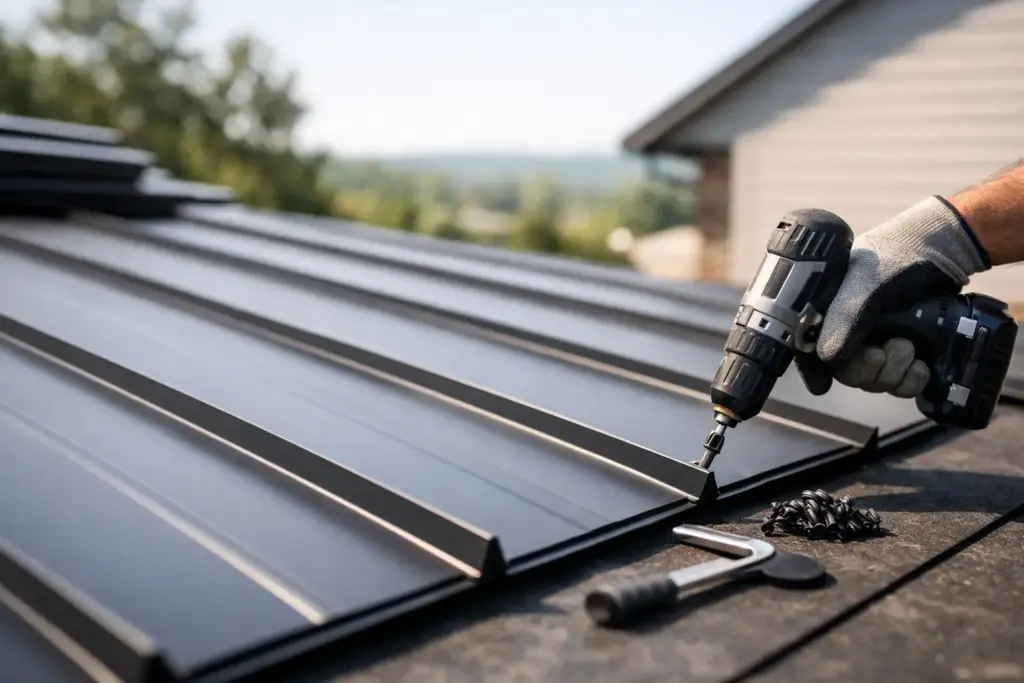
A roof can look clean on installation day and still fail early if its fastening, flashing, and movement details are wrong. This guide to concealed fastener roofing explains what separates a premium metal roof system from a panel-only installation, especially on Alberta homes exposed to snow loads, wind, hail, and dramatic temperature changes.
Concealed fastener roofing is most often associated with standing seam metal panels. Instead of driving screws through the visible face of each panel, installers secure the panels with clips or hidden fastening flanges. Adjacent panels then lock or seam together, covering the fastening system from view and from direct exposure to the weather.
The result is architectural clarity, but appearance is only part of the value. A properly designed concealed fastener system provides metal panels with room to expand and contract, while keeping critical fasteners protected. For acreage homes, custom builds, and higher-value properties, that combination can support a roof that performs for decades rather than becoming a recurring maintenance item.
What concealed fastener roofing actually means
Not every metal roof with limited visible screws is a true concealed fastener roof. The defining feature is that the attachment points are covered by the next panel, a seam cap, or a locked seam. Standing seam is the best-known example, but profiles differ significantly in how they connect, move, and resist wind.
Some systems use snap-lock panels, where adjacent edges click together. Others use mechanical seams that are folded with specialized tools, creating a tighter and more deliberate connection. Mechanically seamed systems are often selected for lower-slope applications or projects requiring higher weather resistance, although the right choice always depends on roof geometry, pitch, exposure, and manufacturer requirements.
A concealed fastener roof should not be confused with an exposed-fastener metal roof. Exposed-fastener panels can be economical and practical for some agricultural or utility buildings, but their screws penetrate the panel face and rely on gaskets to keep water out. Those gaskets and fasteners require monitoring over time. On a premium residence, the cleaner appearance and protected fastening of a concealed system are usually a better fit.
Why the system matters in Alberta
Alberta weather asks more from a roof than a calm climate does. Metal expands in heat, contracts in severe cold, sheds snow quickly, and can be subjected to substantial wind pressure at ridges, eaves, and roof transitions. A concealed fastener system is designed to manage these conditions, but only when every component is specified and installed as one assembly.
The clips are particularly important. They hold the panel to the roof deck without pinning it rigidly in place. As temperatures change, panels can move in a controlled direction instead of stressing fasteners, distorting seams, or oil-canning excessively. Panel length, roof shape, and the metal selected all affect how much movement must be accommodated.
Snow management also needs careful thought. Smooth metal roofs can release snow more readily than textured asphalt products. That can reduce prolonged moisture exposure, but it can also create a serious hazard at entrances, driveways, decks, lower roof sections, and mechanical equipment. Engineered snow retention may be necessary. It should be attached according to the roofing system design, not added casually after installation.
A metal roof alone will not solve ice dam problems caused by heat loss from the building. Attic insulation, ventilation, air sealing, and eave detailing remain essential. A high-performance roof works best when the building envelope is doing its job.
Selecting the right concealed fastener profile
The best profile is not automatically the tallest seam or the most expensive panel. It is the profile that suits the architecture and meets the performance demands of the site.
For contemporary custom homes, wide standing seam panels can create long, disciplined lines that suit modern forms, steep roof planes, and clean exterior palettes. Narrower panels may better match more detailed elevations or homes with multiple dormers and transitions. Seam height, panel width, finish, and orientation all influence the final result.
Roof slope is a critical technical factor. Lower-slope roofs may need a mechanically seamed panel and enhanced underlayment approach. Steeper slopes offer more options, but valleys, skylights, chimneys, wall transitions, and intersecting rooflines can still determine whether a profile is appropriate. A simple roof with long, uninterrupted runs generally offers the strongest visual result and the most efficient installation. Complex roofs can still perform well, but they demand more precise fabrication and detailing.
Material selection matters as well. Steel and aluminum each have advantages depending on location, design, and desired finish. Premium coated steel is widely used for residential roofing because it provides strength and a broad range of architectural colours. Aluminum is lighter and highly corrosion resistant, though it may be more susceptible to denting in certain conditions and is often priced differently. The decision should account for exposure, design requirements, and the complete system warranty rather than panel cost alone.
Installation quality is the real performance line
Concealed fastener roofing is unforgiving of shortcuts. A panel can be high quality, yet still underperform if it is installed over an uneven deck, fastened with the wrong clips, or finished with improvised flashing.
The roof deck must be sound, flat, and dry. Metal panels will reflect irregularities beneath them, and inconsistent substrate conditions can affect both appearance and drainage. Underlayment selection is equally important. It is the secondary water-shedding layer beneath the metal and must suit the roof’s slope, temperature exposure, and detailing requirements.
Flashing is where premium installations separate themselves. Valleys, sidewalls, headwalls, penetrations, eaves, rakes, and ridge details must manage water while allowing the panels to move. These parts cannot be treated as decorative trim. They are functional components that determine whether wind-driven rain and snowmelt remain outside the building envelope.
Penetrations require special discipline. Plumbing vents, flues, skylights, solar mounts, and snow retention systems should be planned before the roofing work begins wherever possible. Cutting into a finished standing seam roof for an unplanned accessory can introduce unnecessary risk. Coordination between the roofer, builder, mechanical trades, and solar provider protects the roof from avoidable compromises.
Cost, maintenance, and lifecycle value
Concealed fastener roofing typically costs more upfront than asphalt shingles and many exposed-fastener metal systems. The difference reflects material quality, specialized labour, custom trims, clip systems, underlayment, and the time required to complete detailed work correctly.
That higher initial investment can make sense when evaluated over the building’s lifecycle. A well-specified metal roof can avoid the repeated replacement cycles associated with shorter-life materials, while offering better resistance to wind, fire, and temperature swings. It also supports the architectural value of a custom home in a way that commodity roofing often does not.
Maintenance is low, not absent. Property owners should have the roof inspected periodically, particularly after severe hail or wind events. Gutters and valleys should be kept clear, sealant-dependent details should be checked when applicable, and snow retention should be reviewed before winter. Avoid allowing untrained trades to walk on the roof or attach equipment without understanding the panel system.
Questions to ask before approving the work
A serious roofing proposal should identify more than a panel colour and square-foot price. Ask which panel profile is being installed, how it is attached, what underlayment is included, and how valleys and penetrations will be detailed. Confirm whether the system is appropriate for the roof slope and whether snow retention has been considered for pedestrian areas.
It is also reasonable to ask who will fabricate and install the critical flashings, whether the crew has experience with the specified system, and what warranty applies to both materials and workmanship. A clear answer is a sign of a contractor who understands the work. Vague assurances are not a substitute for a defined roofing assembly.
The right concealed fastener roof is not simply a better-looking metal roof. It is a coordinated system of panels, clips, deck preparation, underlayment, flashing, ventilation, and site-specific snow planning. When those details are handled with discipline, the roof becomes a long-term part of the property’s protection and architectural value – built to stay that way through Alberta winters.