
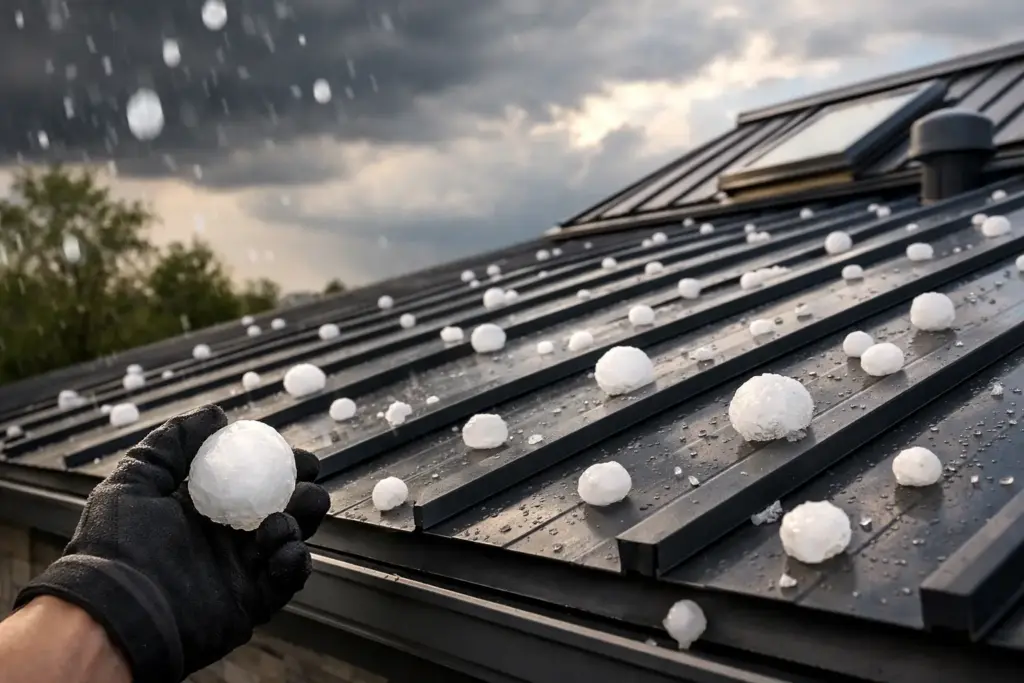
A July storm can turn a good-looking roof into an insurance file in less than 20 minutes. In Alberta, that is not a rare event. It is one of the main reasons more homeowners and property owners are asking serious questions about hail resistant metal roofing, especially on acreage homes, custom builds, and higher-value properties where roof failure affects far more than shingles.
The key point is simple. Metal roofing can perform extremely well in hail-prone regions, but not every metal roof is equally hail resistant. Material thickness, profile design, substrate support, panel shape, coating system, and installation quality all affect the outcome. If the goal is long-term protection rather than marketing claims, those details matter.
What hail resistant metal roofing actually means
When people hear hail resistant metal roofing, they often assume it means a roof that cannot dent, mark, or sustain any visible impact. That is not a realistic standard for any roofing material. A severe hail event can damage almost anything when stone size, wind speed, and impact angle are high enough.
A better definition is this: a roofing system designed to resist functional damage, maintain weather protection, and reduce the likelihood of premature replacement after hail. That is a more useful way to evaluate performance in Alberta conditions.
Cosmetic effects and functional failure are not the same thing. A roof may show minor denting while still performing properly. On the other hand, a poorly selected or poorly installed system can suffer seam damage, fastener issues, coating breakdown, or flashing failure even if the field panels themselves survive.
Why metal performs differently in hail
Metal responds to impact differently than asphalt shingles. Shingles tend to lose granules, crack, bruise, or tear. Once that surface protection is compromised, water shedding and lifespan can decline quickly. Damage may not always be obvious from the ground, which creates a common problem after storms – a roof looks acceptable until leaks or accelerated wear appear later.
Metal roofing does not rely on granule adhesion in the same way. A properly engineered system is built around panel integrity, secure attachment, and controlled water management. That gives it a strong advantage in repeated freeze-thaw cycles, wind exposure, and hail events.
That said, metal is not one category. Thin exposed-fastener panels installed over uneven substrates do not perform like premium standing seam systems or well-supported metal tiles. The phrase metal roof only tells part of the story.
Which metal roof systems handle hail best
For Alberta homes, the best-performing systems are usually those that combine thicker steel, strong profile geometry, and proper support beneath the panel. Standing seam is often a leading choice because the concealed-fastener design reduces exposure points and creates a cleaner, more controlled system overall.
European-style metal tiles and quality metal shingles can also perform very well when they are manufactured with adequate steel thickness and installed to specification. Their formed profiles can help distribute impact energy, and their modular format can be an advantage in repair scenarios if a localized replacement is ever required.
The weak point is rarely the label. It is usually the build quality of the actual roof assembly. A premium panel installed over poor decking, weak battens, or inconsistent fastening will not deliver premium results.
Thickness matters, but it is not the whole story
Heavier-gauge steel generally resists denting better than thinner material. That is true. But gauge alone does not determine hail performance. The shape of the panel, the depth of the profile, and how firmly the material is supported underneath also change how impact energy is absorbed.
This is why two metal roofs made from similar steel can perform very differently in the same storm. One may come through with minimal visible impact. Another may show widespread cosmetic marking because the panel design or substrate allowed more flex.
Panel profile affects visible damage
Flat surfaces tend to show dents more readily than textured or profiled surfaces. Standing seam panels with broad, smooth pans can look architecturally sharp, but they may reveal cosmetic hail impacts more than a contoured tile profile. That does not always mean they are functionally weaker. It means appearance should be part of the selection process.
For some property owners, especially on custom homes where visual finish matters, that trade-off is worth discussing early. The right answer depends on whether your priority is the cleanest contemporary look, the lowest chance of visible marking, or the best balance of both.
Hail resistance is also an installation question
A metal roof is only as reliable as the way it is installed. This is where many comparisons go off track.
A well-designed system needs correct underlayment, proper deck condition, accurate flashing work, disciplined fastener placement, and detailing that accounts for movement in extreme temperature swings. Alberta roofs expand and contract hard. If the system is not installed with that in mind, storm performance suffers over time.
Edges, valleys, penetrations, and transitions matter just as much as the field panels. During a hail event with wind-driven rain, water does not test the easy parts of the roof. It tests the workmanship. That is why premium roofing is not just about buying better material. It is about building a roof assembly that performs as one system.
What property owners in Alberta should watch for
In this climate, roof selection should be based on more than hail alone. Snow load, wind uplift, ice management, and temperature movement all work together. A roof that performs well in one category but poorly in another is not really a long-term upgrade.
For acreage homes and exposed sites, wind can increase the force and angle of hail impact. For custom builds, architectural complexity creates more flashing transitions and detailing requirements. For investors and long-term owners, lifecycle cost matters just as much as the initial quote.
That is why the conversation should move past simple product claims. Ask what metal is being used. Ask about gauge. Ask how the panel is supported. Ask how vulnerable areas are detailed. Ask what kind of finish is being specified and how it holds up after repeated weather exposure.
Insurance, appearance, and the real cost question
Many owners start with one question: will hail resistant metal roofing save money? Sometimes yes, but not always in the way people expect.
The biggest financial benefit is often reduced frequency of major replacement, lower risk of hidden storm-related deterioration, and more predictable maintenance over the life of the property. On a higher-value home, avoiding repeated asphalt replacement cycles can change the long-term cost picture significantly.
Insurance considerations may also matter, but those vary by provider, policy, location, and damage classification. Cosmetic denting versus functional damage can become an important distinction. That is another reason to choose a system with realistic expectations. If preserving a pristine visual finish after every storm is the standard, profile selection becomes more important.
For many Alberta owners, the best value is not the cheapest roof or the roof with the boldest hail claim. It is the roof that keeps protecting the building without becoming a recurring project.
When metal may not be the perfect answer
Metal is an excellent fit for many Alberta properties, but there are cases where system choice needs more discussion.
If a project is highly budget-driven and the decision is based only on the lowest installed cost, premium metal may not align with the short-term objective. If the home design calls for a very specific visual style, certain profiles may fit better than others. And if an owner is highly concerned about even minor cosmetic denting, some metal configurations may be less suitable than textured or more heavily profiled alternatives.
This does not weaken the case for metal. It simply means better outcomes come from matching the roofing system to the property, the exposure, and the owner’s expectations.
Choosing a roof that works long-term
The strongest case for hail resistant metal roofing is not that it is indestructible. It is that a properly selected and properly installed metal roof can offer a higher level of resilience in a climate that regularly punishes weak systems.
For Alberta homes, especially custom residences, acreages, and properties where long-term asset protection matters, that resilience is not a luxury feature. It is part of sound building practice. Hazinasky Roofing LTD. approaches metal roofing the same way serious property owners do – as a long-life exterior system that needs to perform structurally, visually, and financially.
If you are comparing roofing options after a storm or planning a build meant to last, the better question is not whether metal can resist hail. It is whether the specific roof you are considering is engineered and installed to handle the conditions your property will actually face.
One Response