
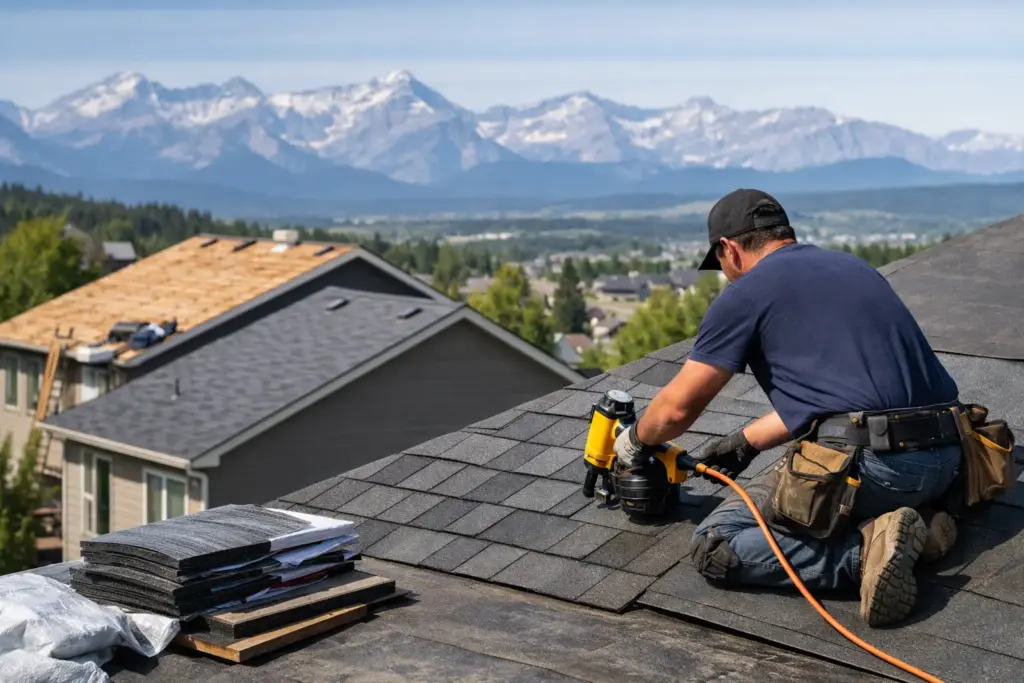
A roof can look acceptable from the driveway while the details that protect the home are already failing: lifted flashings, worn pipe boots, brittle shingles, or underlayment that has reached the end of its service life. For Alberta property owners, roof replacement cost is not simply a price per square foot. It is the cost of protecting a high-value structure through heavy snow, wind exposure, hail, and repeated freeze-thaw cycles.
The right budget starts with one clear distinction: a lower initial number is not always a lower ownership cost. A properly specified roof system can reduce repair cycles, protect the building envelope, and support the architectural value of the property for decades.
What Drives Roof Replacement Cost in Alberta
Every roof has a material cost, labour cost, and scope cost. The scope is where estimates can differ substantially. Two homes with similar floor areas may require very different budgets because roofs are measured by their actual surface area, pitch, access, penetrations, valleys, and edge details – not by the size of the home alone.
A simple, low-slope gable roof is generally more efficient to replace than a steep, multi-level roof with dormers, skylights, chimneys, and complex valleys. Acreage homes can also involve longer travel distances, staging requirements, and more challenging material handling. These are legitimate project variables, not arbitrary additions.
For premium metal roofing, the chosen profile matters as well. Standing seam systems, European-style metal tiles, and metal shingles have different material requirements, fastening methods, and installation sequences. A roof designed for clean architectural lines and long-term performance requires precision at every transition, not just broad coverage across the roof field.
The Main Parts of a Roofing Estimate
A clear roof replacement estimate should account for the complete system. The visible roofing material is only one component. On a long-life roof, the supporting layers and finishing details are equally important.
Removal and disposal
Removing an existing roof can reveal conditions that were not visible during an exterior review. Multiple layers of old roofing, deteriorated decking, poor previous repairs, or trapped moisture may need to be addressed before the new system is installed. Disposal costs also vary with roof size, material type, and access to the property.
Installing over an old roof may appear to save money, but it can limit inspection of the deck, add unnecessary weight, and make future issues harder to diagnose. For a premium installation, a clean substrate is usually the stronger starting point.
Decking and structural preparation
Roof sheathing must be sound, dry, and properly fastened. If sections are soft, delaminated, or damaged by moisture, replacement is not optional if the goal is a durable result. In some cases, ventilation improvements, framing corrections, or new blocking are also required to support the roofing system correctly.
This work can affect the final budget, but it protects against a costly mistake: installing premium material over a compromised base.
Underlayment, ventilation, and ice protection
Alberta winters place real demands on roof assemblies. Ice protection at vulnerable areas, high-quality underlayment, and a ventilation strategy suited to the home all influence long-term performance. These details help manage moisture and temperature movement beneath the roof covering.
They should not be treated as minor line items. A roof can have excellent metal panels or tiles and still underperform if the layers below are poorly specified or carelessly installed.
Flashing, penetrations, and edge work
Chimneys, vents, skylights, valleys, walls, and eaves are where workmanship becomes visible over time. Properly formed flashing, snow-retention planning where required, and secure edge detailing are essential in wind and snow conditions.
A low quote may omit or simplify these details. That is why comparing estimates only by total price can be misleading. Ask what is included around every penetration and transition, not just what material covers the main roof area.
Material Choice Changes the Long-Term Equation
Asphalt shingles are often selected because they carry a lower upfront cost. For some properties and budgets, they can be a practical short-term solution. However, they are a shorter-lifecycle material and may require replacement more than once during the period a quality metal roof remains in service.
Premium metal roofing has a higher initial investment, particularly when it is installed as a full system with proper underlayment, flashings, and ventilation. The value is in its expected longevity, resistance to wind, low maintenance requirements, and architectural finish. It is especially well suited to custom homes, acreage properties, and projects where repeated replacement is not an acceptable plan.
The most suitable profile depends on the home. Standing seam metal delivers a clean, modern appearance with concealed fastening. European-style metal tiles can provide a more dimensional, refined roofline while retaining the performance advantages of metal. Metal shingles may suit homes that need the character of a traditional roof form without accepting a short service life.
Material is never the whole decision. A well-made panel installed poorly is not a premium roof. Installation standards, expansion allowance, fastening layout, flashing execution, and substrate preparation determine whether the system performs as designed.
Why Alberta Climate Makes Cheap Roofing Expensive
Alberta roofs face more than cold weather. Chinooks can create rapid temperature changes. Snow accumulation puts sustained load on roof structures. Strong winds test every exposed edge and fastening point. Hail can shorten the life of many conventional roof coverings.
These conditions make lifecycle planning more valuable. A roof replacement should be designed around the actual exposure of the property. A sheltered urban lot and an open acreage home are not the same project. Wind exposure, roof orientation, nearby trees, elevation, and snow drifting patterns can all affect the recommended system and detail package.
For homeowners who plan to hold a property long term, the question is not only, “What will this cost now?” It is also, “What repairs, disruption, and replacement costs am I avoiding later?” That is the point where a premium system often becomes easier to justify.
How to Compare Roofing Quotes Properly
A detailed quote gives you a basis for comparison. A one-line price does not. Before deciding, confirm whether each contractor has included tear-off, disposal, deck repair allowances, underlayment, ice protection, flashings, ventilation components, metal trim, and warranty terms.
You should also ask who will perform the installation and how the roof will be detailed around valleys, walls, chimneys, and penetrations. Metal roofing is specialized work. The contractor’s familiarity with the specific system matters as much as the product name on the quote.
Be cautious with unusually low pricing. It may reflect a different material gauge, reduced preparation, omitted components, inexperienced labour, or an estimate that leaves important work to be priced later. A lower quote can be valid, but only when the scope is truly equivalent.
Planning a Budget Without Guesswork
The most reliable way to budget is through a site-specific assessment. A professional review should measure the roof, identify access and safety needs, assess the existing assembly, and discuss the performance expectations for the property. This is particularly important for older homes, custom builds, and large rural properties where generic online calculators cannot account for the real scope.
It is sensible to keep a contingency for concealed decking or structural repairs discovered after tear-off. That is not a sign of poor planning. It is recognition that some conditions can only be confirmed once the existing roof is removed.
For a major exterior project, consider the roof in relation to connected elements such as soffit, fascia, eavestroughs, cladding transitions, and wall flashings. Coordinating these components can create a cleaner finished result and prevent unnecessary rework later. Hazinasky Roofing LTD. approaches premium roofing as part of the full exterior performance of the property, not as an isolated layer.
A Roof Is a Capital Decision
The best roof replacement cost is not the lowest number on an estimate. It is the investment that matches the property, climate exposure, and length of ownership while delivering dependable protection year after year.
If your current roof is nearing the end of its life, begin with a detailed evaluation rather than a rushed material choice. A well-defined scope gives you the clarity to install the right system once, protect the home properly, and move forward with confidence.