
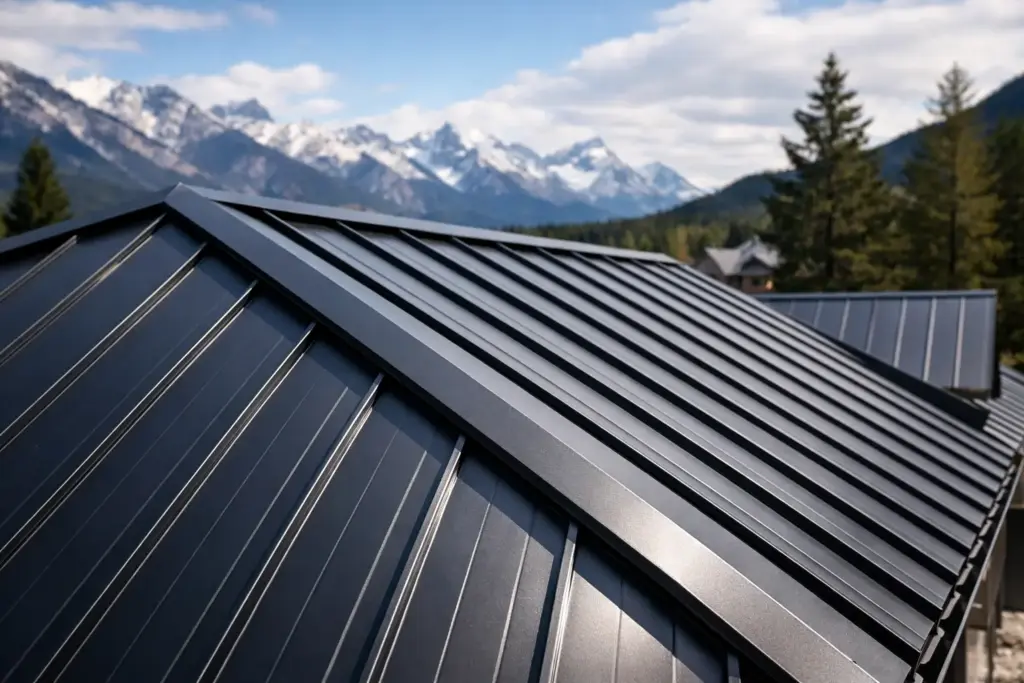
A roof that looks sharp on day one means very little if it starts failing after a few hard winters. For Alberta homeowners, builders, and property owners, the real question is not just appearance – it is service life. The standing seam roof lifespan is one of the main reasons premium projects move away from conventional asphalt and toward properly engineered metal systems.
A well-built standing seam metal roof can last 40 to 70 years, and in some cases longer. That range is wide for a reason. Material grade, panel profile, coating quality, roof design, ventilation, and installation standards all play a direct role in how long the system performs. In Alberta, climate adds another layer. Snow load, chinook-driven temperature swings, wind exposure, hail risk, and UV exposure all test a roof differently than in milder regions.
If you are comparing roofing options for a custom home, acreage property, or long-term investment, lifespan should be measured as real performance under local conditions, not just a brochure number.
What standing seam roof lifespan really means
When people hear that a metal roof can last 50 years, they often assume that means every part of the system remains untouched for half a century. That is not how roofing works. Lifespan refers to the expected service life of the roof system when the right material is used, details are executed correctly, and maintenance is not ignored.
The panels themselves often outlast many of the accessory components around them. Flashings, sealants in certain detail areas, snow retention hardware, pipe boots, and fastener-related components may need attention earlier than the primary roof panels. That does not mean the roof has failed. It means a premium roofing system still depends on proper inspection and upkeep over time.
For higher-value properties, that distinction matters. The goal is not to avoid every maintenance item forever. The goal is to install a roof structure that does not cycle through full replacement every 15 to 25 years.
Typical standing seam roof lifespan by material
Not all standing seam systems deliver the same result. The metal itself sets the baseline for longevity.
Steel standing seam roofs are widely used because they offer strong structural performance and solid value. When manufactured with a high-quality protective coating and installed correctly, steel systems commonly reach 40 to 60 years. In Alberta, coated steel is often a practical fit because it handles snow, wind, and freeze-thaw conditions well when the specification is right.
Aluminum standing seam roofs can also perform for decades, often in the 40 to 60 year range, and they offer strong corrosion resistance. They are especially useful in environments where moisture and atmospheric corrosion are larger concerns. The trade-off is that aluminum is softer than steel, so panel thickness, profile, and project conditions matter.
Copper and zinc can exceed those ranges, but they belong to a different cost category and are usually selected for specific architectural applications rather than mainstream residential roofing. For most Alberta homes, coated steel or aluminum will be the relevant comparison.
Why Alberta climate changes the equation
A roofing system in Alberta does not age the same way it would in a mild coastal region or a dense urban area with less exposure. Large rural and acreage properties often face stronger wind, more drifting snow, and greater exposure across open land.
Winter is the obvious stress test, but summer matters too. UV exposure, heat gain, and rapid shifts between warm days and cool nights create constant expansion and contraction. Standing seam systems are built to manage movement better than many exposed-fastener metal roofs because the concealed fastening and panel design allow controlled thermal response. That is one reason they perform so well over time.
Snow management is another issue. Heavy snow loads can punish weak details around valleys, eaves, penetrations, and transitions. Ice buildup can do the same. A standing seam roof that is designed with proper underlayment, ventilation strategy, drainage planning, and snow retention where needed will generally age far better than one chosen only for the panel look.
Hail also deserves a realistic view. Metal roofing performs well overall, but no material is completely immune to impact. The question is whether hail causes cosmetic marking, functional damage, or premature failure. Panel gauge, substrate strength, and profile depth all affect the outcome.
Installation quality has more impact than most owners expect
A premium panel installed poorly is still a poor roof. In practical terms, installation quality can shorten the standing seam roof lifespan more than the material choice itself.
This is where many roofing comparisons become misleading. Buyers see one contractor pricing a “metal roof” against another, but the systems are not actually equal. Clip spacing, substrate preparation, underlayment selection, panel alignment, flashing fabrication, ventilation planning, and penetration detailing all affect long-term service life.
Standing seam roofing is detail-sensitive. If the installer mishandles expansion and contraction, the panels can oil-can excessively, stress connection points, or create issues at terminations. If flashing details are weak, water entry usually appears at transitions long before the main panels wear out. If trims and accessories are treated as afterthoughts, the roof may look complete while still carrying long-term failure points.
That is why disciplined installation standards matter more on premium homes. The roof is not just a covering. It is part of the property’s performance envelope.
Design choices that affect long-term performance
The roof shape itself influences longevity. A simple gable or straightforward sloped design is easier to waterproof and typically easier to keep performing over decades than a roof with repeated dormers, dead valleys, short panel runs, and multiple penetrations.
That does not mean complex architecture should avoid standing seam. It means the detailing needs to match the complexity. More transitions create more opportunities for water management errors. More penetrations mean more components that may need future service. More intersecting planes can trap snow and debris if drainage planning is poor.
Panel profile also matters. Taller seams, stronger panel geometry, and properly engineered attachment methods can improve weather resistance and structural reliability. In a high-wind or high-snow region, those are not cosmetic differences.
Maintenance still matters, even on a premium metal roof
One of the strongest selling points of standing seam roofing is low maintenance, but low maintenance is not the same as no maintenance.
A professional roof inspection from time to time helps catch small issues before they become expensive ones. Sealant in specialty details can age. Snow retention systems should stay secure. Debris should not be allowed to collect in drainage paths. Penetrations and flashings should be checked, especially after major weather events.
For acreage homes and larger custom properties, annual or periodic inspection makes sense because access is often limited and exposure is higher. The cost is minor compared with the value of preserving a roof system built for long service life.
Lifespan versus cost over time
Standing seam roofing usually costs more upfront than asphalt shingles. That part is obvious. What matters more is the replacement cycle.
If a lower-cost roof needs replacement two or three times over the period that one standing seam system remains in service, the financial picture changes. Add disposal costs, labour inflation, disruption to the property, and the risk of intermittent leaks during shorter roof cycles, and the premium option often becomes easier to justify.
For builders and investors, there is also asset quality to consider. A durable, architecturally clean roof supports resale confidence and reduces the chance of a major envelope issue appearing during ownership or due diligence.
For homeowners, it is a way to stop treating the roof as a recurring problem. Install it once. Done right.
How to get the longest standing seam roof lifespan
If lifespan is the priority, the right approach starts before the first panel is ordered. Choose a system suited to Alberta conditions, not a generic metal product. Match panel profile, metal type, and finish quality to the property and exposure level. Make sure the roof design accounts for snow movement, drainage, ventilation, and thermal expansion.
Just as important, work with a contractor who treats standing seam as a specialized system rather than a sideline offering. That standard of execution is often what separates a roof that performs for decades from one that starts showing preventable issues far too early.
For clients building or upgrading premium homes, this is where Hazinasky Roofing LTD. sees the difference firsthand. The longest-lasting roofs are rarely the result of one magic material. They come from correct system selection, precise installation, and details that are built for the climate they will face.
A standing seam roof is not the cheapest roof you can buy. It is one of the few roofing systems that can genuinely make sense over the long term for Alberta properties where durability, appearance, and predictable performance all matter. If your roof is meant to protect a serious asset, lifespan should be treated as a design decision, not a sales claim.
2 Responses