
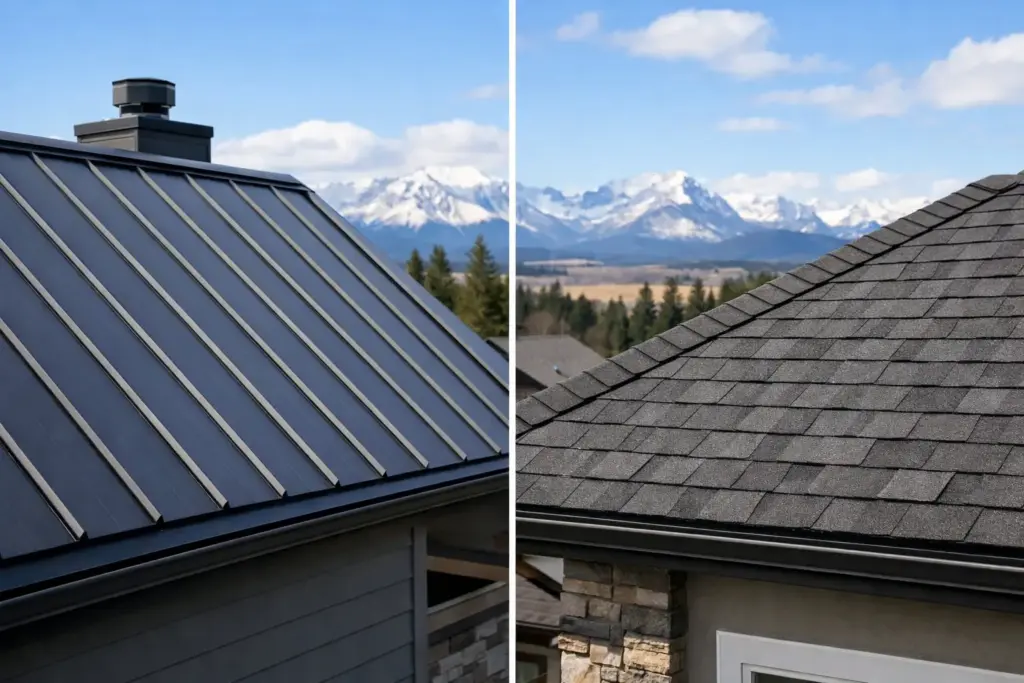
A roof in Alberta does not get an easy life. Snow loads, chinooks, hail risk, high winds, and hard temperature swings expose every weakness in material choice and installation. That is why the standing seam vs shingles conversation matters more here than it does in milder regions. For higher-value homes, acreage properties, and custom builds, the right answer is rarely about the cheapest quote. It is about how the roof performs over decades.
Standing seam vs shingles: what changes in real life
On paper, both systems keep water out. In practice, they behave very differently once weather, maintenance, lifespan, and appearance are factored in.
Asphalt shingles are the standard option because they are widely available, familiar to most contractors, and lower in upfront cost. They can work well on many homes when the budget is tight or the ownership horizon is shorter. But they are still a layered, exposed-fastener system made up of many small pieces. Over time, wind lift, granule loss, sealant aging, and repeated freeze-thaw cycles start to matter.
Standing seam is a premium metal roofing system built from long, continuous panels with concealed fasteners and raised seams. It is designed for water shedding, expansion and contraction, and long service life. The system is cleaner architecturally and more disciplined in how it handles weather. That difference is not cosmetic alone. It affects performance, maintenance, and the probability of future repair work.
For Alberta property owners who plan to keep a home long-term, or who want roofing that aligns with a custom build rather than simply covering it, standing seam usually enters the conversation for good reason.
Upfront cost vs long-term cost
This is where most comparisons start, and fair enough. Shingles generally cost less to install upfront. For some projects, that alone makes the decision. A speculative build, a resale-focused renovation, or a property with a limited capital budget may not justify a premium system.
But upfront cost is only part of the financial picture. A shingle roof is more likely to need replacement sooner, more likely to require intermittent repair, and more exposed to weather-related wear. If a property owner expects to re-roof more than once over the lifespan of the home, the initial savings can narrow quickly.
Standing seam costs more because the material is more substantial, the detailing is more exacting, and the installation standard is higher. That premium buys a system with a much longer service life, lower maintenance exposure, and stronger lifecycle value. For owners who think in terms of decades rather than the next few years, that matters.
For investors and builders, there is also the issue of predictability. Repeated roofing work is disruptive. It affects budget planning, occupancy timing, and the condition of the asset. A longer-lasting system often makes more sense once those variables are counted honestly.
Performance in Alberta weather
Weather is where this comparison becomes less theoretical.
Snow and ice
Standing seam is exceptionally effective at shedding snow and moving water off the roof plane. The smooth surface and vertical panel design reduce areas where water can linger. That helps during freeze-thaw cycles, especially on roofs with proper slope and detailing. Snow retention systems can also be integrated where controlled shedding is needed.
Shingles can perform adequately in snow, but they rely more heavily on the integrity of each layered component. Ice dam risk, water backup, and aging under repeated winter stress can become more noticeable over time, particularly if ventilation and underlayment are not handled correctly.
Wind resistance
Alberta wind is not a minor consideration, especially on open acreage homes and exposed sites. Shingles are more vulnerable to wind lift because each shingle tab is individually exposed. Once edges loosen or seal strips weaken, damage can spread section by section.
Standing seam panels are mechanically secured and designed to resist uplift more effectively when installed properly. That makes them a stronger choice for exposed properties where wind is a routine condition, not an occasional event.
Temperature swings
Metal expands and contracts, but a properly designed standing seam system is built to accommodate movement. That is one of its core strengths. The panel profile, clips, and concealed fastening method are part of a system intended to manage thermal change.
Shingles also experience stress from expansion, contraction, and UV exposure, but they do not manage that movement in the same way. Over years of seasonal cycling, brittleness, cracking, and adhesive fatigue become part of the maintenance story.
Appearance and architectural fit
Not every roofing decision is purely technical. On a custom home or high-value property, the roof is a major part of the architecture.
Shingles are visually familiar and suit many conventional residential styles. If the goal is a standard neighbourhood look or a cost-conscious finish, they can be perfectly acceptable. But they rarely elevate a home.
Standing seam creates a cleaner roofline, sharper detailing, and a more intentional exterior. It pairs especially well with modern homes, transitional designs, estate properties, and projects where exterior materials are selected as a complete composition. The result is more disciplined and more permanent in appearance.
That visual restraint is one reason premium property owners choose it. A roof should not look temporary on a permanent home.
Maintenance and repair reality
Every roof needs inspection. The difference is how often problems tend to appear and how extensive they become.
Shingle roofs are more likely to need attention as they age. Missing tabs, lifted sections, flashing issues, and localized weather damage are common repair points. In some cases, repairs are straightforward. In others, matching older shingles becomes difficult, and small failures turn into broader patchwork.
Standing seam generally requires less ongoing intervention when the system is properly specified and installed. There are fewer exposed vulnerabilities, and the material itself is more stable over time. That does not mean maintenance drops to zero. Sealants, flashings, penetrations, and accessories still need professional review. But the overall maintenance burden is usually lower and more predictable.
For owners managing acreage homes or multiple properties, that reduced maintenance demand has real value. Less attention required often means fewer surprise costs.
Installation quality matters more than the material alone
This is the part many articles miss. A premium roof installed poorly is still a problem.
Shingles are common, which means installation quality can vary widely. Some crews move fast, and on straightforward roofs that may be enough. But on complex rooflines, valleys, transitions, penetrations, and exposed sites, average workmanship shows up later.
Standing seam demands more precision. Panel layout, clip placement, expansion planning, flashing details, substrate preparation, and trim execution all matter. It is less forgiving of shortcuts, but that is also why it performs so well when done correctly.
For that reason, standing seam is not just a material upgrade. It is an installation discipline. Property owners comparing quotes should not evaluate a premium metal system as if it were simply another interchangeable roofing product. The contractor’s system knowledge matters as much as the panel itself.
When shingles still make sense
There are cases where shingles are the right choice.
If the budget is fixed and the project cannot absorb a premium system, shingles may be the practical route. The same applies to properties with a shorter ownership timeline or homes where the architectural value does not justify a higher-spec roof. A well-installed shingle roof is still better than a premium roof chosen on paper but compromised during execution.
What matters is making that decision with open eyes. Shingles solve the immediate roofing need at a lower cost. They usually do not deliver the same long-term performance, design quality, or maintenance profile as standing seam.
When standing seam is the better investment
If the property is custom, exposed to harsh weather, or intended as a long-term hold, standing seam is often the stronger answer. It suits owners who want fewer replacement cycles, cleaner architecture, and a roofing system that matches the value of the structure below it.
That is especially true in Alberta, where climate stress is not theoretical. It is annual. On these projects, the roof should be treated as a capital system, not a commodity. Hazinasky Roofing LTD. works in that reality, where roofing decisions are tied to long-term property performance rather than short-term savings alone.
The better question is not simply which roof costs less today. It is which one you want protecting the property ten, twenty, or thirty years from now. For many Alberta homes, that answer becomes clear once the full picture is on the table.