
If you own an acreage home in Alberta, you already know the roof does not get an easy life. Snow load, chinooks, hail, wind, freeze-thaw cycles, and long UV exposure all work against it. That is why choosing a low maintenance roofing option is less about convenience and more about protecting the building, controlling long-term costs, and avoiding repeat replacements.
For higher-value homes and custom builds, the wrong roof usually looks acceptable at first. The problems show up later – granule loss, lifted shingles, flashing failures, ice-related damage, and a maintenance cycle that never really ends. A roof that needs frequent patching is not low cost. It is just expensive in smaller instalments.
What Makes a Low Maintenance Roofing Option
A truly low maintenance roof is not simply a product with a long warranty. It is a roof system that continues to perform with minimal intervention over time. That includes the panel or tile itself, but also the fastening method, flashing details, ventilation strategy, snow and water management, and installation quality.
In Alberta, low maintenance usually comes down to five things. The material needs to resist impact, temperature movement, and moisture. It needs to shed snow and water effectively. It should not rely on exposed elements that degrade quickly. It should hold its shape and attachment in high winds. And it should be installed with enough precision that weak points are not built into the system from day one.
That last point matters more than many property owners realize. A premium material installed poorly can become a maintenance-heavy roof very quickly.
Comparing the Main Roof Types
Asphalt shingles are still common because the upfront price is familiar and the installation is widely available. But they are rarely the strongest answer for owners who want minimal upkeep over the long term. In Alberta conditions, asphalt is often the roof most likely to require periodic repair, replacement of damaged sections, and earlier full replacement than expected. On standard homes with standard budgets, that may be acceptable. On custom homes or properties where lifecycle performance matters, it is often a compromise.
Cedar has architectural appeal, but it asks for ongoing attention. Moisture management, aging, fire considerations, and natural material variation make it a poor fit for anyone prioritizing low maintenance above all else.
Rubber and membrane systems can perform well on low-slope sections, but they are application-specific rather than a universal answer for residential pitched roofs. They can be part of a good building envelope strategy, though they are not usually the first choice for architectural homes that need durability and visual refinement across the full roofline.
Concrete and clay tile offer longevity, but weight, structural considerations, breakage risk, and installation complexity can make them less practical in many Alberta residential applications. Repairing isolated cracked pieces is not always difficult, but these systems are not necessarily the simplest route to low maintenance ownership.
That leaves metal, particularly premium concealed-fastener systems, as the strongest contender in most high-performance residential scenarios.
Why Metal Is Often the Best Low Maintenance Roofing Option
For Alberta homeowners and builders looking at long-term value, metal roofing is often the best low maintenance roofing option because it addresses both durability and maintenance risk at the same time.
A properly specified metal roof does not depend on a field of exposed tabs, adhesive strips, or brittle surfaces to stay weather-tight. It is designed to manage water efficiently, resist wind uplift, and tolerate major temperature swings without the same pattern of surface wear seen in many conventional materials. That matters in a climate where a roof may move from deep cold to direct sun and melt conditions in a very short period.
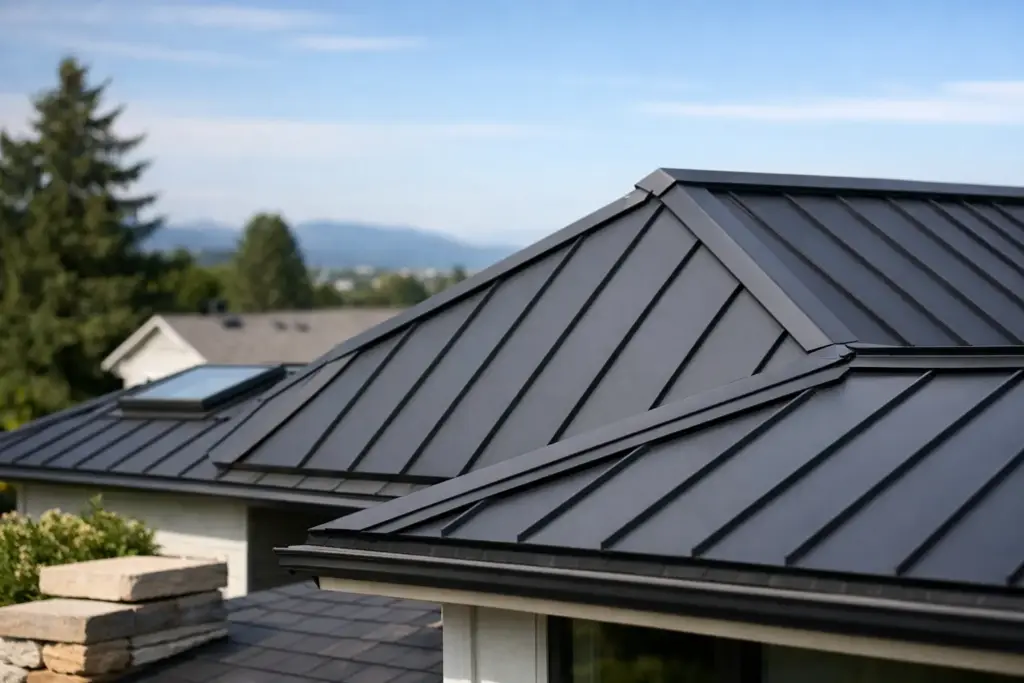
Standing seam metal roofing is particularly strong in this category. With concealed fasteners and clean vertical lines, it offers a disciplined appearance and fewer exposed points where deterioration can begin. European-style metal tiles and metal shingles can also provide excellent low maintenance performance when they are engineered well and installed correctly. The right choice depends on roof geometry, architectural style, and the performance priorities of the project.
Low maintenance does not mean no maintenance. Any roof still needs periodic inspection, especially after major storms. Gutters need to stay clear. Flashings, penetrations, and transitions should be checked. But with a high-quality metal system, the maintenance schedule is lighter, the failure points are fewer, and the chances of routine patchwork are significantly reduced.
Where Homeowners Get This Decision Wrong
The most common mistake is comparing roofs only by initial installed price. That approach tends to make short-lifecycle materials look efficient, even when they are likely to cost more over time through repairs, disruptions, and earlier replacement.
The second mistake is treating all metal roofs as the same. They are not. Exposed-fastener metal products can be suitable in certain applications, but they generally do not offer the same long-term maintenance profile as premium concealed-fastener systems. Fastener movement, gasket aging, and ongoing service needs can become part of ownership. If your priority is true low maintenance, the attachment method matters.
The third mistake is underestimating installation quality. Roofing That Works Long-Term is not just about selecting metal. It is about making sure the detailing is precise at valleys, skylights, eaves, hips, wall intersections, and ventilation points. These are the areas where leaks start when standards slip.
The Alberta Factor
A roof that performs well in a mild climate is not automatically the right answer here. Alberta puts more stress on roofing systems than many regions. Snow retention, drifting, ice behaviour, rapid temperature swings, and open-country wind exposure all change how a roof should be designed and installed.
That is one reason premium metal systems make sense for acreage homes and exposed sites. They are well suited to handling harsh weather without entering a constant repair cycle. But the design still has to match the conditions. Slope, snow management, substrate preparation, underlayment selection, and flashing execution all need to be considered together.
For custom homes, this is also where appearance and performance should not be separated. A roof is one of the most visible parts of the building. If the architecture is refined but the roof material looks temporary or ages unevenly, the whole property feels compromised. The best low maintenance choice is often the one that protects both the envelope and the visual standard of the home.
Is Metal Always the Right Choice?
Not always. If the project is strictly driven by lowest immediate budget, asphalt may still be the practical answer. If the structure has unusual design constraints, another system may be better suited in specific sections. And if the roof is being selected for a short hold period rather than long-term ownership, the lifecycle argument may carry less weight.
But for owners planning to stay, for builders working on premium homes, and for investors who want predictable upkeep, metal usually moves to the front of the conversation very quickly. Install It Once. Done Right. is not just a slogan in this category. It is the economic logic behind choosing a better system from the start.
Choosing the Right Low Maintenance Roofing Option for Your Property
The right decision starts with a clear view of the property, not just the product sample. Roof complexity, exposure, slope, surrounding trees, snow behaviour, and the architectural intent of the home all matter. A simple bungalow in a sheltered subdivision does not ask the same things of a roof as a custom acreage home on an exposed site outside the city.
This is where a specialist approach pays off. A contractor focused on premium roofing systems can help determine whether standing seam, metal shingles, or European-style metal tile is the best fit for the house and the owner’s goals. Hazinasky Roofing LTD. works in that premium category, where the objective is not just to replace roofing but to build an exterior system that performs cleanly and lasts.
When you are evaluating options, ask a harder question than which roof is cheapest today. Ask which roof is least likely to interrupt your time, your budget, and the long-term value of the property. For the kind of homes where quality matters, that question usually leads in the same direction.