
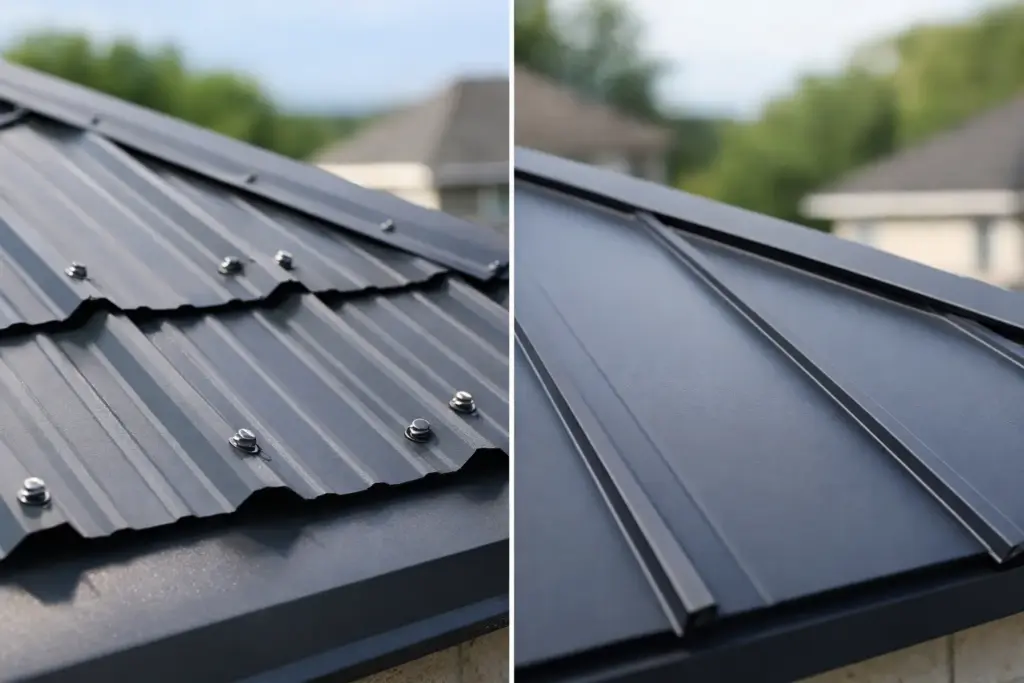
A metal roof can look similar from the driveway while performing very differently over decades. The exposed fastener vs concealed decision is not simply about appearance. It affects how the roof manages thermal movement, how it sheds snow and water, where maintenance may be required, and whether the finished roof matches the standard of the home beneath it.
For Alberta acreage homes, custom builds, and long-term property investments, the right answer depends on roof geometry, architectural intent, budget, and expected ownership horizon. Both systems have legitimate uses. The important part is selecting the system that fits the building rather than choosing the lowest initial price.
Exposed Fastener vs Concealed: The Core Difference
An exposed-fastener metal roof, often called a screw-down panel roof, secures panels directly through the face of the metal and into the roof structure or substrate. Each screw uses a sealing washer intended to keep water out at the penetration point. The fasteners remain visible in organized rows across the finished roof.
A concealed-fastener system holds panels in place with clips, seams, or fastening flanges hidden beneath adjoining panels. Standing seam is the most recognized example. Once installed, the roof surface has no visible field fasteners, creating a cleaner architectural finish and reducing the number of exposed penetrations.
That distinction matters because metal expands and contracts as temperatures change. Alberta roofs can move through severe cold, direct summer heat, chinooks, and rapid temperature shifts. A well-designed concealed system is built to accommodate that movement through its clip and seam arrangement. An exposed-fastener panel is restrained at every screw location, placing more long-term demand on fastener washers and panel holes.
What Exposed-Fastener Roofing Does Well
Exposed-fastener panels are widely used for garages, workshops, agricultural buildings, utility structures, and some straightforward residential roofs. They are typically more economical to purchase and install than premium standing seam systems. On a simple building with an appropriate roof pitch, they can provide reliable weather protection when correctly detailed and maintained.
Their direct fastening method can also make localized panel replacement relatively straightforward. For projects where architectural refinement is not the primary objective, the visible screw pattern may be an acceptable trade-off for lower upfront cost.
The limitation is not that exposed-fastener roofing is automatically poor quality. The limitation is where it is asked to perform. Every visible screw is a penetration through the roof surface. Over time, fasteners can loosen, washers can age, and panel movement can enlarge screw holes. That does not mean a roof will fail overnight, but it does create more components that require inspection over its service life.
On a large, uncomplicated outbuilding, this maintenance profile may be reasonable. On a high-value residence, especially one designed around clean lines and long ownership, it is often less aligned with the overall investment.
Why Concealed Fasteners Suit Premium Homes
Concealed-fastener metal roofing is designed for projects where long-term performance and architecture carry equal weight. With standing seam, the seams create strong vertical lines from ridge to eave, while the fastening system remains protected beneath the panels. The result is a roof that looks deliberate, not utilitarian.
More importantly, concealed clips allow the metal to move as temperatures change without relying on thousands of exposed sealing washers. This is a significant advantage in Alberta’s climate. The roof is still a complete system, not just a series of panels, but reducing exposed penetrations gives water fewer opportunities to reach the substrate.
Standing seam also works particularly well on custom homes with visible roof planes, modern architecture, and complex exterior palettes. It pairs naturally with premium cladding, masonry, timber, and fluted composite board facades because it delivers a controlled, finished appearance from every viewing angle.
Concealed fastening is not limited to standing seam. European-style metal tiles and metal shingles can also use hidden fastening methods, depending on the specific system. These profiles offer a more traditional or textured roof appearance while retaining the benefits of engineered metal construction and protected fastening details.
Snow, Wind, and Water Management in Alberta
A roof system should be selected with local weather in mind, not catalogue photos alone. Heavy snow loads, wind exposure, freeze-thaw cycles, and ice formation all influence material choice and installation details.
Concealed-fastener standing seam systems are commonly specified for challenging conditions because their continuous seams and clip-based attachment are engineered for controlled movement and strong weather resistance. They also provide a compatible surface for properly designed snow retention systems. Snow guards must be selected and placed based on roof layout, entrances, walkways, lower roof sections, and expected snow accumulation. They are not an afterthought.
Exposed-fastener panels can perform well on suitable slopes, but their visible fasteners require greater attention in areas prone to ice damming, wind-driven rain, and recurring freeze-thaw activity. A screw installed slightly too tight, too loose, or out of square can compromise the washer seal. Multiply that risk across an entire roof, and installation discipline becomes critical.
Neither system can compensate for poor flashing, inadequate ventilation, improper underlayment, or weak transition details around chimneys, skylights, valleys, and wall intersections. Most serious roof problems begin at details, not in the middle of a panel. This is why system selection and specialized installation must be considered together.
Cost: Initial Price Versus Ownership Cost
Exposed-fastener metal roofing generally costs less at installation. It uses a simpler panel profile, fewer concealed clips, and a faster fastening process. For the right building, that can be a sensible decision.
Concealed-fastener roofing costs more because the materials, accessory components, layout, and labour demand greater precision. Standing seam panels must be measured, formed, aligned, clipped, seamed, and detailed correctly at every termination. The visible result is cleaner, but the real value is in the system beneath the surface.
The better comparison is not only price per square foot. Consider how long the property will be held, whether periodic fastener servicing is acceptable, how prominently the roof is seen, and what a lower-grade roof could mean for future resale or exterior upgrades. A premium roof on a custom home is not merely a finish selection. It is protection for the building envelope and an investment in predictable ownership.
When an Exposed-Fastener Roof May Be the Right Choice
An exposed-fastener system can be appropriate for a detached garage, shop, barn, storage building, or budget-sensitive structure with a simple roof shape. It may also suit a property owner who understands and accepts the need for periodic inspection of fasteners and seals.
It is less compelling where the roof is a major architectural feature, where the home has high-end exterior materials, or where the owner expects the roof to remain largely hands-off for decades. On those projects, lower initial cost can become false economy if the roof requires more attention than the rest of the property was designed to need.
Roof pitch also matters. Low-slope applications require specific systems, seam heights, underlayment strategies, and drainage details. Do not assume that any metal panel can be installed on any slope. The panel profile and manufacturer requirements must match the roof design.
The Installation Standard Is Part of the Product
A concealed-fastener roof only performs as intended when its details are executed correctly. Panels must be properly aligned, clip spacing must account for wind conditions, seams must be formed to specification, and flashings must allow for movement without creating weak points. The substrate, ventilation, ice-and-water protection, and drainage plan all matter.
The same principle applies to exposed-fastener roofing. Correct screw placement, fastening pressure, lap treatment, closures, and flashing work determine whether a lower-cost system delivers reasonable service life or becomes a source of recurring repairs.
At Hazinasky Roofing LTD., the focus is not on treating metal roofing as a commodity. The goal is to match the system, profile, and installation method to the property’s architecture and Alberta exposure conditions. That is how a roof becomes a long-term exterior solution rather than another item on a future repair list.
A well-chosen roof should look appropriate on the day it is installed and remain dependable through years of snow, wind, sun, and temperature change. For a premium residence, concealed fastening is often the stronger long-term direction. For a practical outbuilding, exposed fasteners may be exactly what the project requires. The right choice starts with an honest assessment of the building, not a one-size-fits-all product recommendation.
2 Responses