
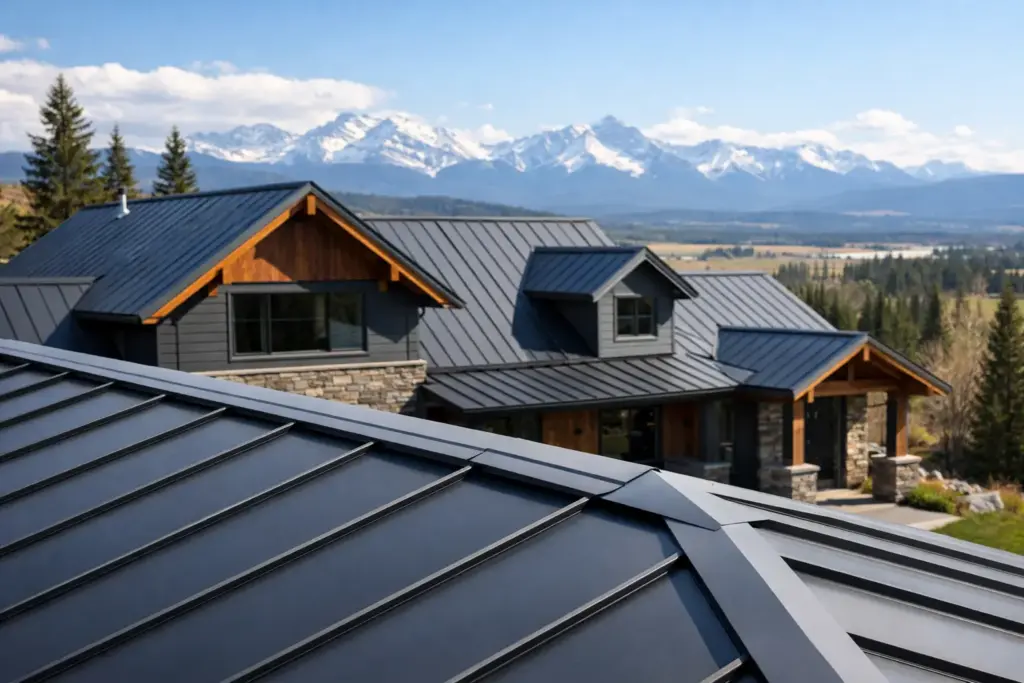
A roof in Alberta does not get an easy life. Snow load, chinook swings, hail exposure, wind uplift, and long freeze-thaw cycles test every material on the house. That is why a proper standing seam roof review should look past showroom appeal and focus on what the system does after ten, twenty, and thirty years.
For the right property, standing seam metal roofing is one of the strongest long-term options available. It is clean in appearance, highly weather-resistant, and well suited to custom homes, acreages, and higher-value builds where lifecycle performance matters. It is not the cheapest roofing choice up front, and it is not forgiving of poor installation. Those two facts are what separate a smart investment from an expensive mistake.
What this standing seam roof review should actually measure
Many reviews stop at aesthetics and price. That is not enough. A premium roof system should be judged on structural behaviour, water management, thermal movement, maintenance demands, and how well the installation matches the climate.
Standing seam roofing performs well because the panels lock together with raised seams, reducing exposed fasteners and creating a more controlled path for water shedding. On paper, that sounds simple. In practice, the real value comes from panel design, substrate preparation, fastening method, flashing details, and installer discipline.
If those elements are right, the roof can deliver decades of reliable service. If they are wrong, even a premium metal system can oil can, leak at penetrations, or fail early around trims and transitions.
Where standing seam roofing performs exceptionally well
In Alberta conditions, standing seam has several clear strengths. The first is weather resistance. Properly installed systems handle snow and rain well because the interlocking vertical seams create a direct drainage path. Water does not rely on a field of exposed screw penetrations the way many lower-cost metal systems do.
The second strength is wind performance. On exposed rural properties and acreage homes, uplift resistance matters. A mechanically sound standing seam system, installed with the right attachment method, is better suited to those conditions than many conventional roofing materials.
The third is longevity. Compared with asphalt shingles, a premium standing seam roof is built for a much longer service life. That does not mean every metal roof lasts the same length of time. Coating quality, panel thickness, underlayment, ventilation, and installation standards all affect the result. But in general, the category is designed for owners who want to install once and avoid repeat replacement cycles.
There is also the architectural advantage. Standing seam has a disciplined, refined appearance that works especially well on modern homes, mountain-inspired builds, contemporary farmhouses, and custom residences with clean rooflines. On higher-end properties, the roof should support the architecture, not visually cheapen it.
The trade-offs most reviews miss
A fair standing seam roof review also needs to address the drawbacks.
The obvious one is cost. Standing seam is a premium system. Material quality, custom fabrication, accessories, and specialist labour all push the price above asphalt and above many entry-level metal roofing products. For owners focused only on lowest initial spend, it will often look expensive.
Noise is another concern people ask about. The short answer is that a properly built roof assembly with correct decking and insulation is not the loud, tinny experience many people imagine. Most of the noise complaints tied to metal roofs come from poor assemblies, not from the standing seam concept itself.
There is also the issue of installer availability. Not every roofing crew should be installing this system. Standing seam rewards precision and exposes shortcuts. Incorrect clip spacing, weak flashing execution, poor panel handling, or inadequate allowance for thermal movement can turn a premium roof into a service problem.
Finally, appearance can be affected by oil canning, which is the visible waviness sometimes seen in flat metal areas. It does not usually affect function, but it can affect expectations. Good product selection, profile choice, substrate quality, and installation technique reduce the risk, but they do not erase physics entirely.
Cost versus value over the long term
This is where standing seam often makes the most sense for the right buyer.
If you compare only installation price, it may be hard to justify against asphalt. If you compare replacement cycles, maintenance exposure, storm resilience, and visual longevity, the economics shift. A homeowner planning to hold a property for many years, or an investor protecting a premium asset, should evaluate annualized cost rather than invoice cost alone.
A roof that lasts significantly longer and reduces the chance of repeated repair work can be the lower-friction choice financially. It may also support resale better on architecturally strong homes where buyers expect premium exterior materials.
That said, not every house needs standing seam. On a basic property with limited remaining ownership horizon, a premium metal system may not be the most rational capital decision. Good roofing decisions are tied to asset value, ownership timeline, and the performance expectations of the property.
Alberta climate fit matters more than trend appeal
A roof system that looks good in a brochure may not be right for prairie weather. In Alberta, snow retention, ice management, ventilation strategy, and trim detailing matter as much as the panel itself.
Homes with steep pitches, broad open exposure, or complex valleys need proper planning. Snow does not simply disappear from a metal roof. It sheds differently, and that affects entrances, walkways, landscaping, and lower roof sections. In some cases, snow retention accessories are part of a complete solution, not an optional add-on.
Temperature movement also matters. Metal expands and contracts. That is normal. A well-designed standing seam system accommodates that movement. A poorly designed one fights it, and the stress shows up over time around fasteners, flashings, and transitions.
For this reason, homeowners should be cautious about buying a standing seam roof as a style upgrade without asking how the full system is engineered for the site. Climate fit is not a sales extra. It is the job.
What separates a good system from a bad installation
Most roofing failures are not caused by the idea of the material. They are caused by execution.
On standing seam, the vulnerable areas are predictable: penetrations, valleys, eaves, ridges, wall transitions, skylights, chimneys, and any place where roof geometry changes. Those details need trained fabrication and disciplined site work. The field panels get the attention, but the trims and flashings decide whether the assembly stays dry.
Substrate preparation is also critical. Uneven decking telegraphs through metal. Poor planning beneath the panel can affect both appearance and performance. Ventilation and underlayment choices matter too, especially in a climate where condensation risk cannot be ignored.
This is why specialist installers matter. A contractor focused on premium metal roofing will approach the project differently from a crew that treats standing seam as an occasional upgrade product. Hazinasky Roofing LTD. operates in that specialist category, where the installation standard is part of the product itself.
Is standing seam right for your property?
Usually, yes, if your home is a custom build, an acreage property, or a high-value residence where long-term exterior performance matters. It is also a strong fit for owners who dislike repeat replacement cycles and want a roof that aligns with a premium architectural finish.
It may be less compelling if the house is nearing redevelopment, if the ownership timeline is short, or if budget pressure makes the decision purely about lowest upfront cost. Premium roofing works best when the owner values lifecycle performance, not just immediate savings.
Design also matters. Standing seam looks best where the architecture supports it. On some homes, another premium metal profile may be a better visual fit while still delivering long service life. The right answer is not always one product. It is the system that matches the building.
Final verdict in this standing seam roof review
Standing seam is not a budget roof, and it should not be sold like one. It is a high-performance exterior system for owners who expect durability, architectural discipline, and fewer long-term compromises.
When properly specified and properly installed, it is one of the most credible roofing investments available for Alberta homes. But the phrase properly installed carries most of the weight. If you are evaluating standing seam, do not just ask what the panel costs. Ask how the roof is detailed, how movement is handled, how snow is managed, and who is responsible for getting every transition right.
A premium roof earns its value quietly, year after year, when the weather turns and nothing about the system asks for your attention.
3 Responses