
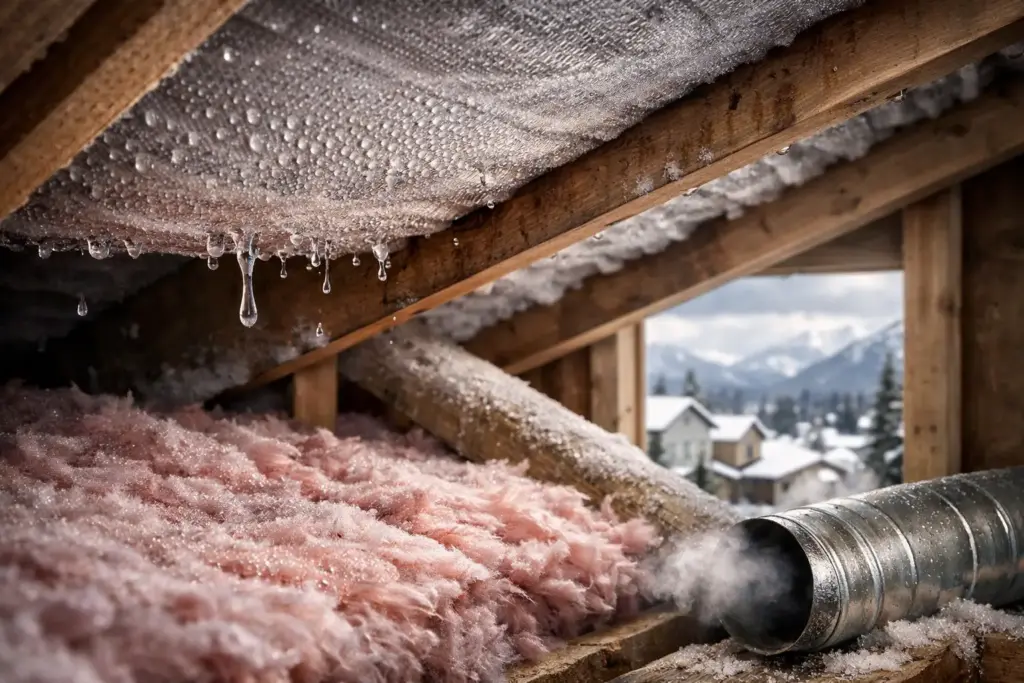
A roof can look flawless from the driveway while moisture is building above the ceiling line. In Alberta, roof condensation causes are often hidden until frost appears in the attic, insulation becomes damp, or staining reaches an interior ceiling. By that stage, the issue is rarely just cosmetic. It can affect timber framing, indoor air quality, insulation performance, and the long-term value of the property.
Condensation is not automatically a roofing failure. It is a building-envelope failure involving heat, air movement, humidity, insulation, ventilation, or several of these conditions at once. The right repair starts by identifying where warm, moisture-laden air is entering the roof assembly and why it is not being managed correctly.
Roof Condensation Causes: The Basic Mechanism
Condensation forms when warm air carrying water vapour reaches a surface that is cold enough to drop below its dew point. During an Alberta winter, the roof deck and attic-side roofing components can become extremely cold. If heated indoor air reaches those surfaces, its moisture can freeze as frost or collect as water droplets.
A bright day can make the problem more visible. Frost melts when temperatures rise, then runs onto insulation, framing, and ceiling finishes. Homeowners may assume the roof is leaking, particularly after snow or a rapid thaw. Sometimes it is a leak. Often, however, the water began inside the home as humidity that escaped into the attic.
The challenge is that several roof condensation causes can produce similar symptoms. A proper assessment looks at the complete assembly rather than treating a wet spot as proof that shingles, metal panels, or flashing alone are at fault.
Air leakage through the ceiling plane
Air leakage is one of the most common and most damaging sources of attic moisture. Warm indoor air moves through openings around pot lights, attic hatches, plumbing stacks, wiring penetrations, bathroom fan housings, chimney chases, and unsealed wall-top connections. Small gaps can move far more moisture than vapour diffusion through a properly installed ceiling membrane.
This is why adding insulation alone does not always solve condensation. Insulation slows heat loss, but it does not stop air movement. In fact, loose-fill insulation can conceal leaks at the ceiling plane while warm air continues to reach the cold attic.
A sealed and continuous air barrier is the first line of defence. It must be detailed carefully around every penetration, especially on custom homes where ceiling geometry, vaulted areas, lighting layouts, and mechanical systems create more opportunities for leakage.
Insulation gaps and cold spots
Insulation keeps interior heat where it belongs and helps maintain a more stable temperature at the ceiling plane. When coverage is thin, compressed, displaced, or interrupted around framing and mechanical services, cold surfaces develop more easily.
The issue is not always the total insulation depth. A home may meet a target R-value on paper yet have weak areas at eaves, attic perimeters, around access hatches, or beneath truss webs. These local cold spots can become the first places where frost develops.
Insulation must also remain dry. Once wet, many insulation materials lose performance. That allows more heat to escape, increases the risk of continued condensation, and turns a seasonal moisture event into a repeating cycle.
Ventilation that is blocked, unbalanced, or poorly designed
Attic ventilation helps remove incidental moisture and moderates attic temperature. It is not a substitute for air sealing, but it remains an essential part of many vented roof assemblies.
Soffit intake vents blocked by insulation, inadequate exhaust near the ridge, and disconnected vent channels are frequent problems. So is relying on a small number of roof vents to serve a large or complex roof. Air needs a clear path from intake to exhaust. Without that path, stagnant pockets of cold, damp air can remain trapped in valleys, low-slope transitions, or isolated attic sections.
More ventilation is not always the answer. Oversized exhaust without adequate intake can draw conditioned air from the house through ceiling leaks. The goal is balanced, continuous airflow designed for the roof shape and assembly, not a collection of vents added after the fact.
High indoor humidity and unvented appliances
Homes produce moisture every day through showers, cooking, laundry, plants, and normal occupancy. Tightly built homes retain more of that moisture, which is good for energy efficiency only when ventilation and humidity control are addressed properly.
Bathroom fans that discharge into the attic are a direct source of roof condensation. Dryer vents, kitchen exhaust, and high-efficiency mechanical equipment also require correct routing and termination. A disconnected duct can release a significant volume of warm, humid air into a cold roof space.
Indoor relative humidity must be managed according to outdoor temperature. A level that feels comfortable during mild weather may be too high during a severe cold snap. Large homes with pools, spas, extensive glazing, or high occupancy may need more deliberate humidity control than a standard residence.
Construction moisture and recent renovations
New construction and major renovations introduce large amounts of moisture through concrete, framing lumber, drywall compound, paint, and other materials. If the building is enclosed and heated before those materials have dried sufficiently, moisture can migrate into the roof space.
This does not mean every new roof problem is temporary. Persistent frost, dripping, or mould still requires investigation. But timing matters. A newly completed custom build may need its ventilation, humidity settings, and drying period reviewed before more invasive roof work is prescribed.
Why Alberta Roofs Face Greater Condensation Risk
Alberta’s temperature swings create a demanding test for every roof assembly. A home can experience mild daytime conditions followed by deep overnight cold. The greater the difference between interior and exterior temperatures, the more aggressively warm indoor air moves toward colder parts of the building.
Heavy snow adds another variable. Snow cover can change roof-surface temperatures and conceal flashing or drainage issues, while wind-driven snow can expose weaknesses at vents and transitions. These factors can occur alongside attic condensation, making diagnosis more complex.
Acreage homes deserve particular attention. They often have larger roof areas, complex rooflines, vaulted ceilings, attached garages, mechanical rooms, and additions built at different times. Each transition needs to maintain a continuous air, vapour, insulation, and ventilation strategy. One overlooked connection can compromise an otherwise high-quality roof system.
Signs the Problem Is Condensation, Not a Simple Leak
A roof leak is usually tied to a specific exterior defect and may become worse during rain, wind-driven precipitation, or snowmelt. Condensation often follows a different pattern. It tends to appear during prolonged cold weather, across broad areas of roof decking, or near attic penetrations and exterior walls.
Look for white frost on the underside of the roof deck, darkened sheathing, damp or matted insulation, rusty fasteners, mildew odours, and water staining that appears after a thaw. Condensation may also show up as dripping around light fixtures, ceiling registers, or attic hatches.
Do not rely on appearance alone. Water can travel along framing or under insulation before it becomes visible. An inspection should assess roof penetrations and flashings from the exterior, then review attic conditions, ducting, insulation depth, ventilation routes, and air-sealing details from inside.
Metal Roofing Does Not Cause Condensation
Metal roofing is sometimes blamed because metal cools quickly and can show condensation clearly when an assembly is poorly controlled. The material itself is not the cause. A correctly designed metal roof system can perform exceptionally well in Alberta, but it must be installed as part of a complete assembly.
For a vented roof, that may include a properly sealed ceiling plane, adequate insulation, clear soffit-to-ridge ventilation, and details that prevent snow or rain entry. For low-slope or compact assemblies, the solution may depend on continuous insulation, a well-defined vapour control layer, and specific ventilation requirements. The correct approach depends on roof geometry, insulation location, interior humidity, and the existing structure.
Standing seam systems, metal tiles, and metal shingles also require precise underlayment, flashing, fastener, and ventilation detailing. Premium roofing materials protect the exterior for decades, but they cannot compensate for an attic that is receiving humid indoor air every day.
What a Long-Term Repair Looks Like
A lasting repair is targeted. First, confirm whether the moisture is coming from the interior, the exterior, or both. Then correct the source before replacing damaged insulation or finishes. Sealing an attic hatch while ignoring an unvented bathroom duct, for example, produces an incomplete result.
The repair may involve air sealing penetrations, improving insulation coverage, clearing soffit baffles, correcting ridge exhaust, rerouting mechanical vents, or adjusting indoor humidity. If roof sheathing has deteriorated, affected materials should be replaced only after the moisture pathway has been addressed. Otherwise, new materials are exposed to the same conditions.
For higher-value homes, this is where disciplined roofing and exterior coordination matters. Roof transitions, wall interfaces, skylights, mechanical penetrations, and ventilation components should be treated as one performance system. Hazinasky Roofing LTD. approaches premium metal roofing with that standard in mind: install the visible roof correctly, and protect the structure beneath it for the long term.
A dry attic should not be a matter of luck or a temporary response to the weather. When the roof assembly is correctly designed, sealed, insulated, and ventilated, it protects the home quietly through Alberta’s hardest winters.
One Response